
 |
6-29-4, All day today was in preparation to paint on the mural tomorrow morning. I've been wetting the the area since 8 AM. Picking the brushes, trowles, palettes laid out, stringing up the grid lines on the wall and in chalk on the acrylic color layout painting, Wetting and protecting lower faux marble with a cover, watching Maria Sharapova win her match at Wimbledon. This is the scaled acrylic paintng I made for this mural. I chose the top morning scene. 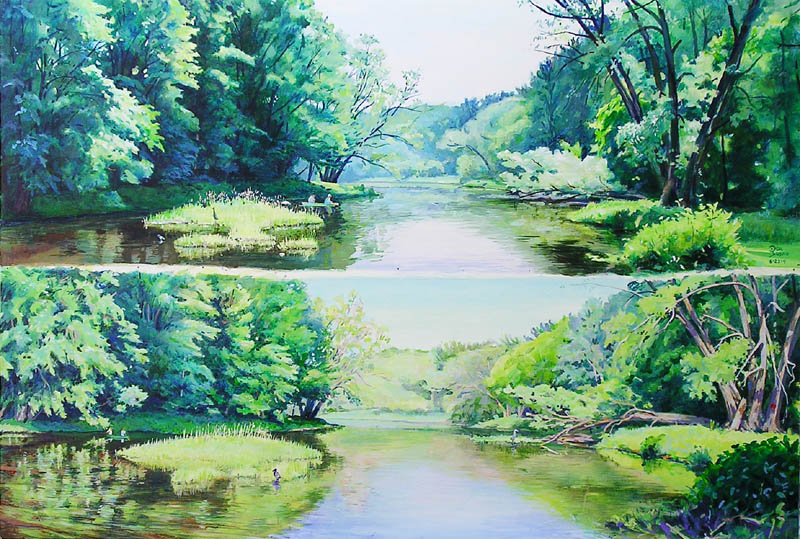 This will be a 3"x3" giornate using three transparent colors plus white. These are the primary transparent pigment colors that make a full color painting. Their mass colors match the transparent crystals of yellow, magenta and cyan including the way they become dark. These are the true transparent primary colors and the basis of the Real Color Wheel. Just as a note, PR122 quinacridone violet, is warmer then PM202 quinacridone magenta. Normally I use PR122 in acrylics and w/c but this is a cool mural and I only have PM202 which is perfect to make great blues. The horizontal and vertical lines are strings, strung as the grid lines. With this grid I can transfer my paintings' chalk grid.
This is how I set up the string guides. 6-30-4, 10:45 start laying intonaco mortar. On top of the wet Brown coat I put a thin wet intonaco slip coat on with a brush. Wash them in alcohol or vinegar to remove the lime. By the time this was finished it was ready for the full coat. I used my home made 12" plexie glass blade to smooth the surface. 12:20 finished laying the intonaco mortar. I'll wait until after lunch before starting to paint. 2:10, 100% coverage of color, I'm half way done.
5:30, finished giornate #1. My 1" Langnickle 901 Blitz Fitch brush was the one the flowed the big pigment best. It always was a great brush, I used up my 1/4, 1/2, and 3/4 Series 901 a few years ago, they are not replaceable. 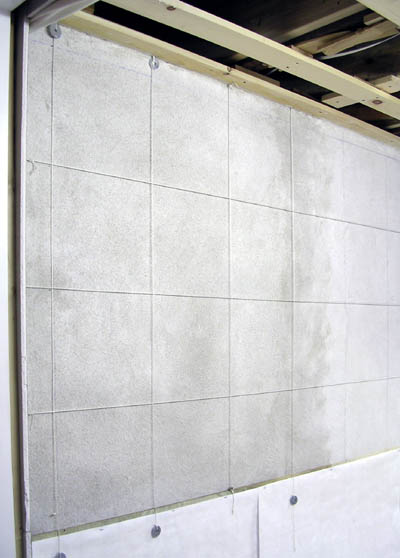 5:30, finished giornate #1. My 1" Langnickle 901 Blitz Fitch brush was the one the flowed the big pigment best. It always was a great brush, I used up my 1/4, 1/2, and 3/4 Series 901 a few years ago, they are not replaceable. This is the clean giornate #1 with string grids and my transfered outlines. TIP: Note to myself, make the cut lines early, before it sets, for a smoother edge. 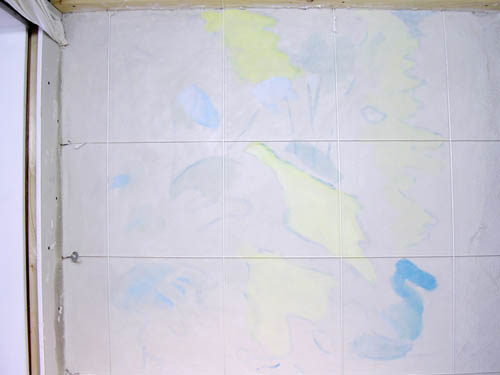 Horray! My bag of crushed limestone arrived! Now I will have a white intonaco.
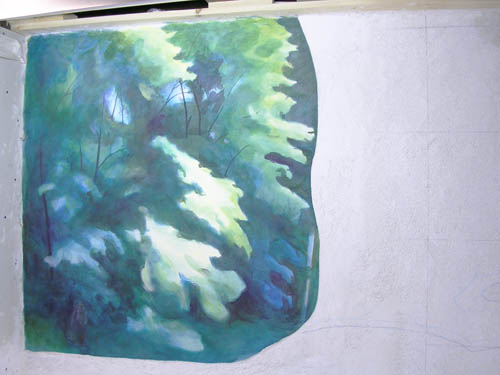 Giornate #2, 1 white cement, 1.5 lime, 2.5 crushed limestone, = 2.5:2.5, 1 water. 7-2-4, 9:30 start laying giornate #2, Rub a loose slip thin layer of intonaco mortar on first with a brush dipped in lime water to soften the lime mortar. Spread the intonaco along the old edge first, get that good. Then spread the rest roughly, then a big float trowel or sponge to even it out, then a metal or plexie glass blade to make it ready for pigments. 11:10 finished laying giornate #2. 11:30, Cut off the extra with a pointed trowel while the giornate is wet, so the edges will be smooth, clean off the extra so it won't fall on anything painted. Later I started using a "V" cut. Paint the connected edges first because they will dry out first. Second, cut the giornate lines 12:00 painting 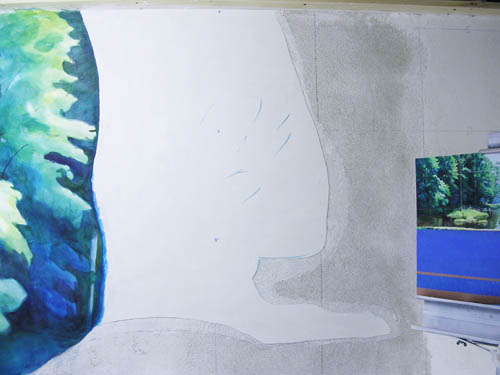 First paint where the dark areas are. 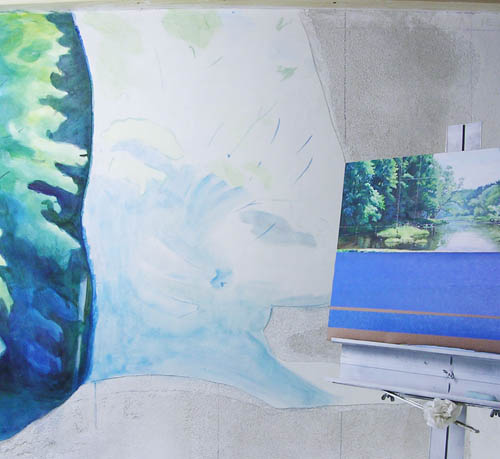 2:00, Finish breakfast. It has 100% coverage, It's hard to build up color fast, these are transparent colors and the washes are thin and they do sink in quickly. The color is dark and 10 seconds later it's lighter. Colors just don't move after they are laid. 3:00, I think it closed out but I'm not sure, three hours isn't enough. 4:30, Finished 2nd giornate. It's better to make a giornate cut along a pattern color edge then down the middle of a color pattern. Light colors are especially hard to match and the cut shows. I painted this giornate without my string guides, I made dots at all the corners, this was easier but not quite as accurate. The kayak is a paper cutout I could move into position. 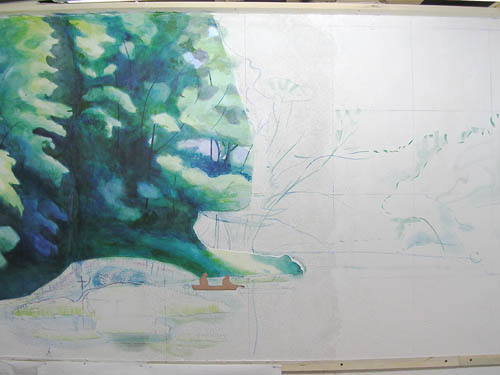 7-4-4, Happy Fourth of July. They set off 1/4 sticks of dynamite for noise up here.
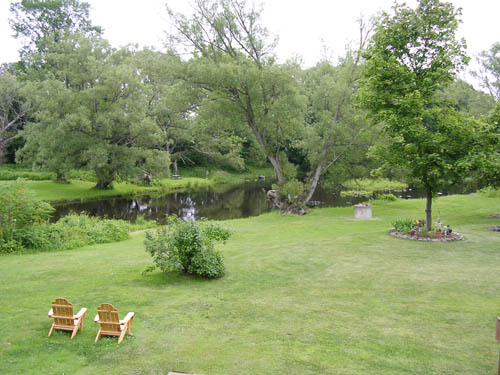
7-5-4, All day I've been drawing the cartoon. It's never ending.. I don't want to put 6M holes in it, I guess the spoon will have to do it's work and scribe in the lines as I go along. 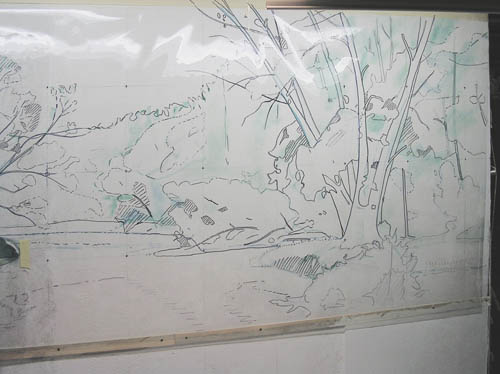 This is the lower left foreground with the crane that lives here and a kayak. It's drawn in black marker on clear plastic. 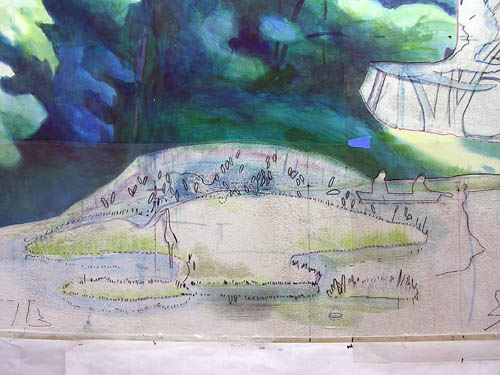 7-7-4, 11:00, Giornate #3, 1 lime, 1 crushed limestone. To start laying the center top giornate, the sky area. First I had to wet the whole area plus until the shine stayed a while, with special treatment for the edges because it dries there first. The outline for the giornate on the brown coat was in red so it was fairly easy to follow. The first coat of intonaco was with a sponge with loose slip mortar. The second coat was spread as thin as I could. The third and final layer of the intonaco was smooth and level, 3/16 " thick max. TIP: The following step will be to cut the giornate edges with a two stroke "V" cut and remove the excess mortar in the V. Do this before painting to insure against accidents. The intonaco is down, here shows the scribe lines and the cut being removed. 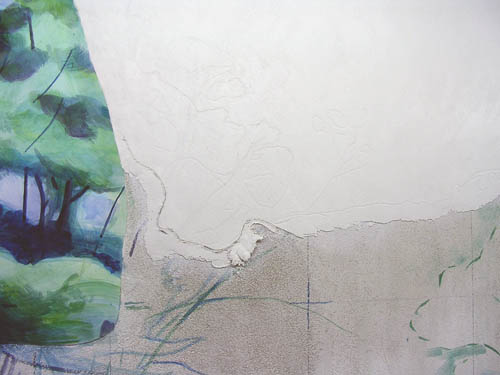 3:15 Pm, the sky is finished, I can take a break. In the pigment I added titanium white and plenty of lime paste. On this same giornate are the trees on the left and right. I figure I have three hours to do them. 5:45, finished painting giornate #3, the sky is perfect. The delicate balance of cyan and magenta and yellow mixed with lime paste and titanium white made a beautiful sky of pink and blue. TIP: While I was making the pink color I put some of the color that was too intense but still made with lime paste on the dry brown coat wall below. Two hours later the color was locked onto the wall solid and insoluble. Lime paint has been around a long time, lime white-wash is what it was called, it was a house paint. The Egyptians added color to it. Secco painting needs a glue additive to adhere the pigment and a sealer. Contemporary was casein, egg yolk or lime. Techniques used by the ancients on dry walls include the 'Lost Art' of Cera Colla, which was both the glue and the gloss and made walls shine. 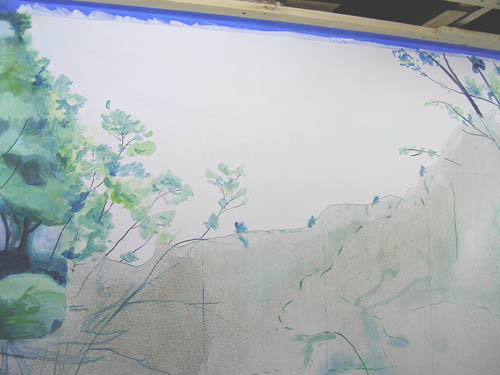
9:00, Wet the new wall in the morning until it holds a sheen. That took 2 hours by hand. Keep the forward and below areas wet with a spray bottle of lime water.
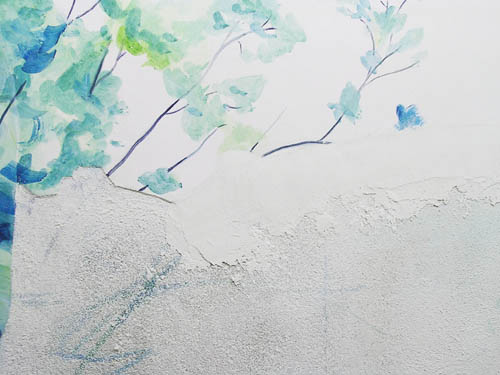 Keep spraying your working area plus the next area every 15 minutes, if it's too dry it will suck the water out of the intonaco mortar and the bond will be lost causing shrinkage to show as cracks. Spray the working pile of mortar also and remix it to keep the right consistency in the whole little batch. 2:15, Finished laying #4 giornate with a flatter continuous beveled edge on the right and a 45 degree angle at the bottom. In this photo the test permanent pink hue made with lime on the dry brown coat can be seen. It is permanent. 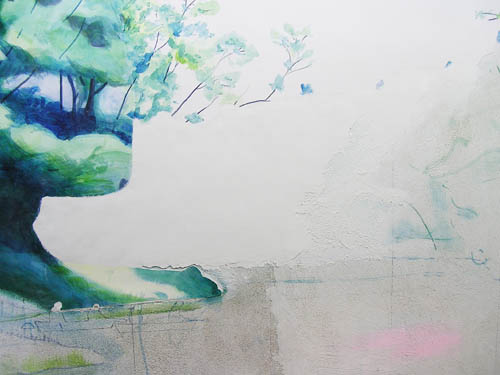 4:15, Still too wet to paint on, I'll wait another 45 minutes before transferring the cartoon. 7:35, I love the bristle brush, just like Steve on our fresco forum said. It's grreat.
Use a soft wash brush for dark colors. Do this first because it will take more than one wash. It's easy to paint light over dark when you mix lime paste into the lighter colors. TIP: Here is how I know what color a wet color with lime in it a will dry into.
I must say I'm using a lot of lime paste now that I'm confident that colors mixed with paste are permanent even if applied to mortar after it has set. That would be secco painting.
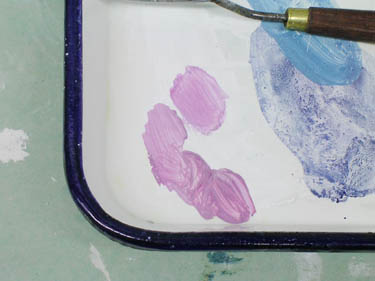 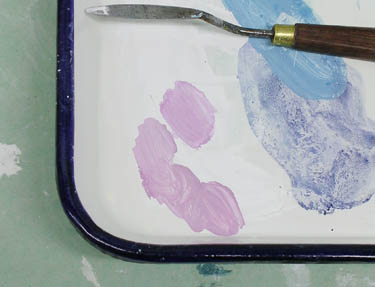 9:45, 4th giornate finished. 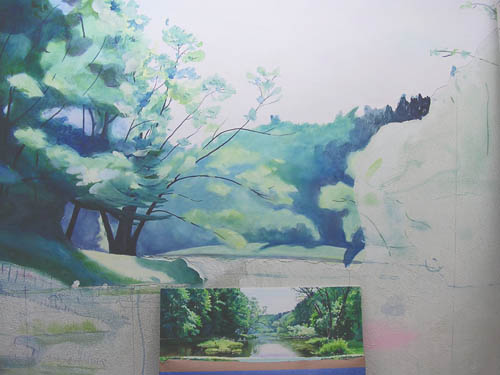 PAGE BREAK 1 |
These links are to other 3 primary color paintings, the pigments are:
Dry Pigments;
Indian yellow PY153 from Zecchi
Magenta PR122 from Sennelier
Cyan PB15.3 from Senopia
Syn. Food Coloring
The Easter Egg Coloring 6-pack.
Transparent pigments; yellow, red, magenta, blue, cyan, green.
Oil Paints,
Old Holland Indian Yellow Orange-side
Daniel Smith Quinacridone Magenta PR122
Grumbacher Thalo Blue, cyan PB15.3
Water Colors,
Daniel Smith "New Gamboge" PY153 Nickel Dioxine is the best Indian Yellow O/s pigment,
bad name, good transparent pigment.
Daniel Smith Quinacridone Magenta PV202 is more to the cyan side, bad choice.
The most stable magenta color matching pigment is PR122, 36RCW#13magenta.
The 36 RCW includes all pigment colors, that's why I use it.
Grumbacher Thalo Crimson PV19 is more to the warm side 36RCW#12,
it's fugitive compared to PR122
Grumbacher Thalo Blue, cyan PB15.3
Children painting with Food Coloring Colors First Grade learning the primary colors.
3 color examples Mixing the three transparent primary colors.
Lime Water Media 75 sq. foot Buon Fresco in 3 colors.
Lime Water Medium Buon Fresco Painting #1 in 3 colors.
Lime Water Medium Buon Fresco Painting #2 in 3 colors.
Maroger Medium Hana Paintings with Maroger's Medium in 3 primary colors.
Maroger Medium The Kaupo Hearts, Black Oil painting in 3 primary colors.
Egg Tempera Medium Still Life in 3 primary colors.
Water Color Painting with 3 primary colors.
Copal Medium with the RCW 3 Color Wheel
NEXT, Large mural continued, 2 of 4
PREVIOUS, Preparation for this mural
END PAGE Last Painting w/tips
JOIN THE PAINTING ON LOCATION COLOR FORUM
