|
Dec 7 2004
12-8-4
12-09-04
12-10-4
|
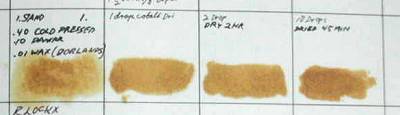
The balance is just right in this Maroger's gel, I can remove yesterday's work with turpentine and leave the day before that alone. There is a noticable difference between the two layers. That's a good point when your working layers.
12:53, Never saw the heart light up. I have simplified the farground, when the correct lighting shows up for the heart I'll know which ridge edges should get sunlight.
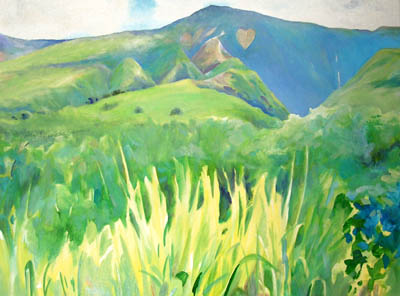 |
I moved the heart and enlarged the head of this cliff. Changes are easy and very blendable, it took an hour.
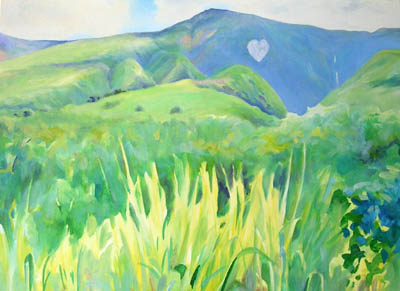 |
Last night the weeds got cut and changed my view. So I changed my picture. Another big change happened when another heart appeared.
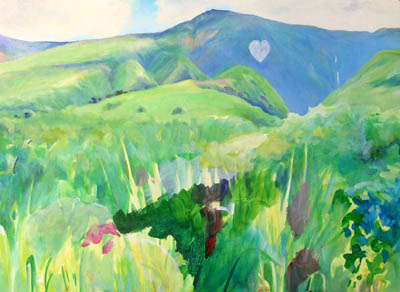 |
Notice the chalk lines drawn on the dry mountain. In oils it's rare to be able to do this. In acrylics it's a normal technique.
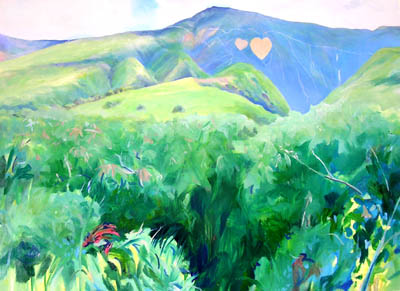 |
I hate to lose the whole top of the mountain to the clouds but it's the only why I've scene this simularcrumb natural image.
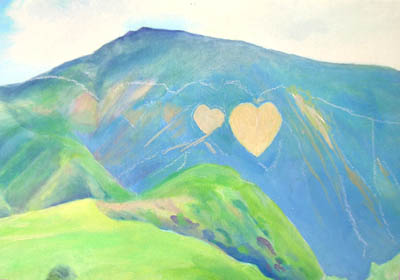 |
Tomorrow I'll give the clouds some color and shape.
The new foreground will be dry to work on. 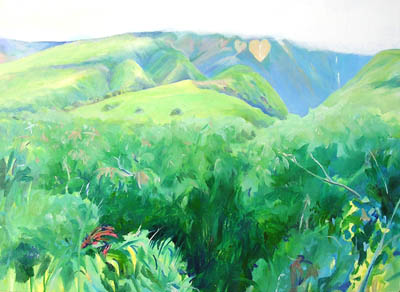 |
Today for the first time I saw the myth I had heard about. There were hearts on the mountain, not just one.
I made the sketch of light and dark patterns on my notepad.
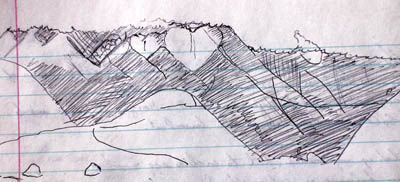 |
The heart is not lit up too brightly here in this photo, but I know now what is possible.
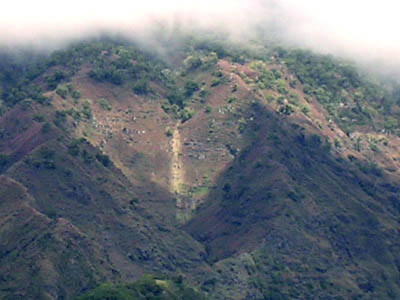 |
|
Kaupo Heart #1,
12-14-04
I'm going to capture the light in the tunnel.
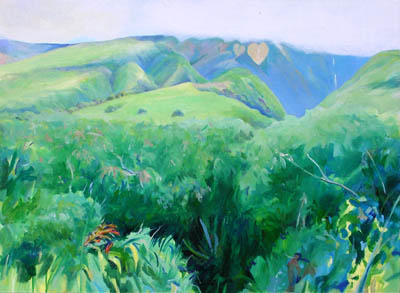 |
Kaupo Heart #1,
12-17-04
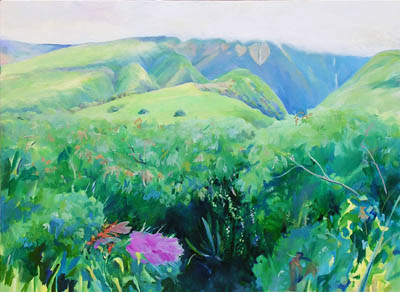 |
|
Kaupo Heart #1,
12-15-04, finished.
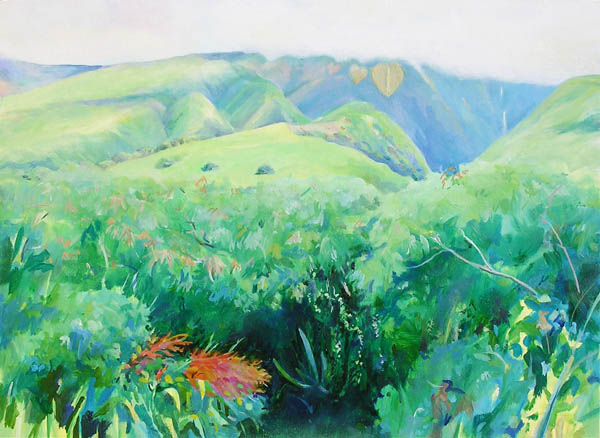 |
|
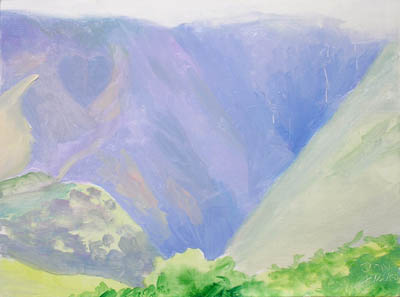
12-10-4 3:30, 5.5x7.5 second painting Kaupo Heart #2, primary color painting.
When using just 3 colors mixing time is a big factor.
|
 |
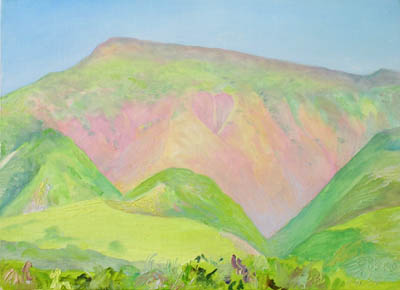 |
12-11-04
9:30, third painting of the heart in the transparent primary colors. Two hours.
|
|
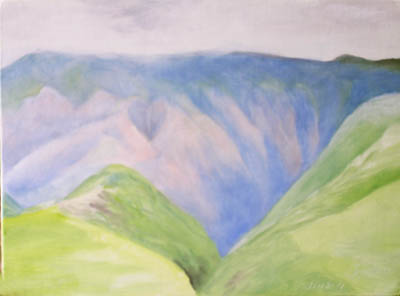
12-12-04, 9:30, I'm using the Red, Yellow Blue palette today. Cad yellow light, cad red light, French ult. blue and white.
Poor greens, it's that same green you get when you mix black and yellow. Clean blues, no cyan, good yellow, chalky orange, no magenta, dirty purple.
I missed my cyan that's for sure. This opaque RYB triad taught in schools is sad compared to the transparent yellow, magenta and cyan palette.
|
 |
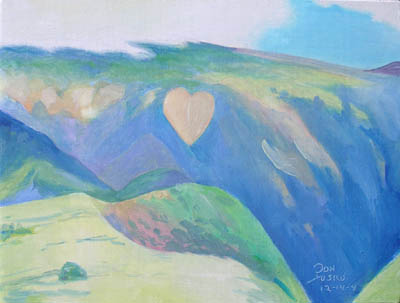 |
12-14th
10:30, photographed two dark hearts, they show up all the time. Start the 4th painting of the heart in the primary colors.
|
These links are to other 3 primary color paintings, the pigments are:
Dry Pigments;
Indian yellow PY153 from Zecchi,
Magenta PR122 from Sennelier,
Cyan PB15.3 from Senopia.
Food Coloring
The Easter Egg Coloring 6-pack.
Oil Paints,
Old Holland Indian Yellow Orange-side,
Daniel Smith Quinacridone Magenta PR122,
Grumbacher Thalo Blue, cyan PB15.3
Water Colors,
Daniel Smith's New Gamboge is PY153 Nickel Dioxine, the Indian Yellow Orange/s pigment. I don't like the name.
PY150 Nickel Dioxine is the Indian Yellow Brown/s pigment.
Daniel Smith's w/c Quinacridone Magenta PV202 is more to the cyan side.
Grumbacher Thalo Crimson PV19 is more to the warm side.
The most stable and magenta matching pigment is PR122.
Grumbacher Thalo Blue PB15
Children painting with Food Coloring Colors First Grade learning the primary colors.
3 color examples Painting with the three transparent primary colors as washed and opaque colors.
Lime Water Media 75 sq. foot Buon Fresco, three permanent primary colors.
Lime Water Medium Buon Fresco #1, three permanent primary colors.
Lime Water Medium Buon Fresco #2, three permanent primary colors.
Maroger Medium Hana Paintings with Maroger's Medium, three permanent primary colors.
Maroger Medium The Kaupo Hearts, Black Oil painting in , three permanent primary colors.
Egg Tempera Medium Still Life, three permanent primary colors.
Water Color Painting with, three permanent primary colors.
Copal Medium with the RCW 3 Color Wheel
PREVIOUS MAROGER PAINTING, Maroger's Black Oil Painting, maroger htm
NEXT PAINTING, Anna's Bouquet in 3 Transparent Primary Pigments, Copal Medium, annabouquet.htm
PREVIOUS PAINTING,
Egg Tempera Painting, eggtempera.htm

