eXTReMe Tracker
These little palette colors will take you to new windows
Dioxine Purple Ultramarine Blue Cobalt Blue Thalo Cyan Blue Turquoise transparent Green Opaque Thalo Green
Burnt Umber Real Color Wheel in Pigments Permanent Green Light
Burnt Sienna
Venetian Red Yellow Green Opaque
Yellow Oxide
Naples Yellow Light Green Gold Transparent
Magenta Rembrandt Rose Cadmium Red Medium Cadmium Orange Indian Yellow Gold transparent Cadmium Yellow Medium Cadmium Yellow Pale
and describe each pigment
color on the colorwheel.


This is the only transparent 3 primary color wheel like this,
copy it if you are an artist, teacher, or someone working with color.
It matches natures way of making crystals dark.

Use this Real Color Wheel to match pigments that are the correct neutral-dark color mixing complements.
Use it for mixing shadows and shade colors without using black pigment.
Use it for making 18 different complement sets and 648 split-complement sets.
A color wheel designed by a color artist painting only on location for 30 years and taking color notes.

It matches crystal color oppositions.
Cyan is from the copper element and makes Thalo blue,
the copper crystal has cyan's opposite red color.
Lead makes a blue crystal and a yellow oxide.
Quartz makes a long magenta and green crystal.

Original Real Color Wheel
This transparent 3 primary color-crystal color wheel joins together
the colors of Light, Crystals and Pigments.


Free RCW tif in RGB & CMYK printable zip.


Q. Why is a Real Color Wheel handy?
Q. When you're on location painting or photographing and arranging colors, how do you use it?
A. While painting you see an object. Take the brightest local color on it and mix in its opposite color to darken and shadow it.
Here are the correct oppositions to make all shadows or colors that look good together. It takes a lot of memorizing to know each colors opposite so it's handy to read the color in nature and see the opposing pigment on the RCW color wheel.
http://www.wikihow.com/Use-the-Real-Color-Wheel


For the Printer and Plotter artists, see the gamma differences between an RGB profile and a CMYK profile.

RCW Color Theory, 2-23-13

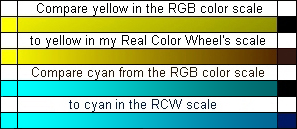
Real Color Wheel Comparison Chart
The yellow & cyan RGB scales go to black
This mistakenly cools the yellow colors and warms the cyan colors
Naples yellow, ochers & umbers should be under yellow
Cyan should darken like the sky colors

Color elements make transparent colored crystals which join light and pigment colors.


Real Color Wheel and Red-Green-Blue colorwheels use the same 36 intense rim colors.
The Red-Green-Blue RGB light spectrum that the computer uses subtracts light to darken colors so only the pure rim colors and tints are similar to the colors of the Real Color Wheel.
The RCW matches the way a transparent crystal elements becomes darker.
This RCW comes in CMYK for pigment color reproduction and RGB for computer work. The RCW computer colors now match the CMYK pigment colors used as inks in my giclee printer and pigments for painting with all media,

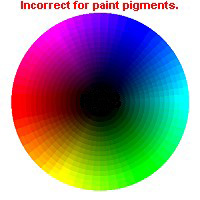
Here are RGB correct tint colors ( 1 ) & ( 2 ) incorrect shadow colors
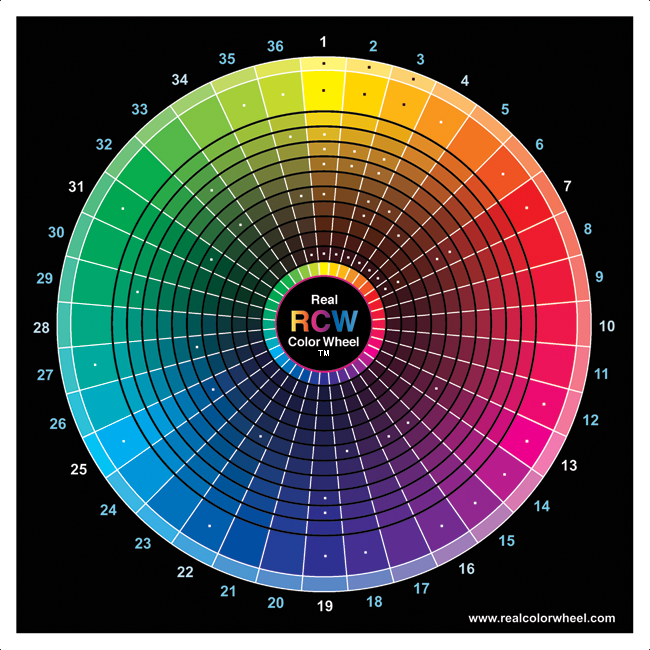
Tint, Real Color Wheel tint colors RGB/YMC colorwheels
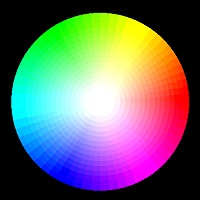
The RGB/CMY colorwheel on is NOT for pigments.
it does not darken as nature or pigment crystals do, it darkens to black effecting the color incorrectly.
Here are the corrected CMYK and RGB to match the Real Color Wheel.

CMYK
CMYK Real Color Wheel

RGB
RGB Real Color Wheel

36RCW#36 Yellow-yellow-green and 36RCW#1 Yellow are colors are side by side, each using 9º of the 360º circle.
Raw umber is the coolest dark pigment for the Yellow color RCW#1.10.1. Green Umber is #36.10.9 and a cooler temperature.
Orange darkens to the brown of red just the same as yellow does, Burnt Sienna is a half-dark orange.
Yellow, orange and red darken to the same dark brown.
Red become lighter by adding orange pigment or more of the transparent primary yellow. I noticed this on a cardinal in sunlight.
Orange objects darken by adding burnt sienna or burnt umber.
Cadmium red light changes to cadmium red medium with the addition of transparent magenta #13, (PR:122).
Cyan, cobalt blue & ultramarine blue darken to the same dark blue, similar to the way yellow, orange & red darken to the same brown in its opposite analogous set of 7 colors.
Cyan is opposite red, when mixed together evenly they make a dark neutral. Red and yellow darken to warm brown, warm brown with cool dark blue make a neutral dark plus all shade and shadow colors for both colors before reaching neutral dark. Any neutral dark can be tinted to a neutral gray tint, matching the underside of a cloud's color.

Transparent magenta and transparent green are opposite, just add any two opposite colors together to get a darker shadow color.


The old Red-Yellow-Blue colorwheel is inaccurate for any artist, compare them.

This CLICKABLE chip color map below shows the true opposition
pigment colors for mixing neutral darks on the color wheel.
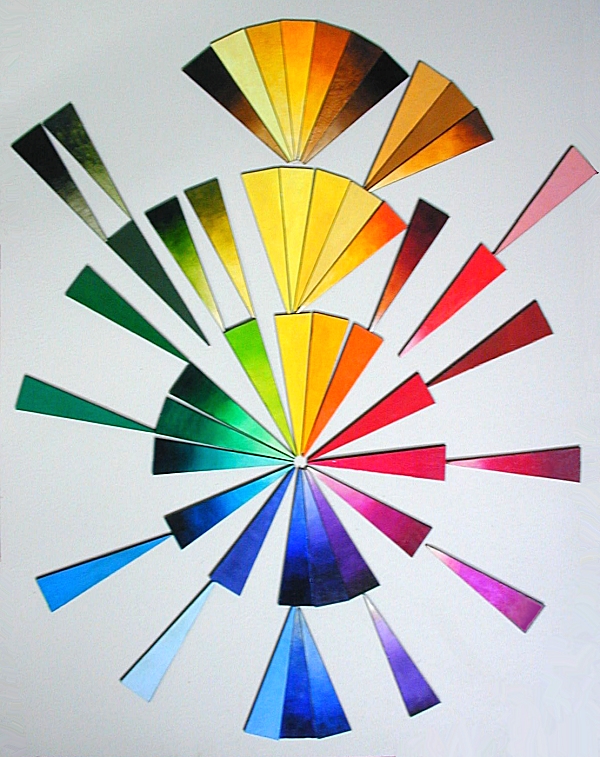
Blockx Yellow Cobalt Old Holland Gamboge Lake Ex. Syn. O.H. Indian Yellow Brown Lake Syn. Rembrandt Asphaltum Syn, very oily Burnt Umber Mussini Zinc Yellow, the coolest yellow. No link Bocour Cad Yellow Lead Chromate Grumbacher Cad Barium Yellow Pale Mussini Naples Yellow Light, Nickle Titanium O.H. Indian Yellow-Orange Lake Syn. Dual-tone Mussini Raw Umber Blockx Baryum Yellow, very weak O.H. Indian Yellow-Orange Lake Syn. Mussini Naples Yellow Deep Yelow Raw Ocher Mussini Trans Yellow Oxide Green Earth Green Gold Nickel Azo Sap Green Syn. dual-tone Green Umber Earth Green Oxide W/N Flesh Burnt Sienna Rewmbrandt Chinese Vermilion syn. O.H. Yellow Green Organic Mussini Cad. Yellow Lemon Mussini Cad yellow Middle Rembrandt Chinese Vermilion Syn Blockx Venation Opaque Warm Red Oxide Cadmium Orange Cadmium Barium Red Light Permanent Green Light Grumbacher Phthalo Green Light Mussini Opaque Green Light Mussini Phthalo Green Turquoise, Rembrandt Blue Green Cadimium Bayrum Red Light Rembrandt Red Rose Rose Madder, Yarka Garance Violet Grumbacher Thalo Blue, Old Holland Manganese Blue O.H. Scheveninge BLue Light Opaque D.Smith Quinacridone Magenta pr122 Cobalt Violet Transparent, Cool Magenta Dual-tone Cobalt Blue Light Mussini Royal Blue Light Blockx French Ult. Bue Ultramarine Violet Dioxazine Purple Mussini Royal Blue Deep Ultramarine Deep Ultramarine Light Dioxazine Purple tints cool


THIS IS NOT AN IMAGE

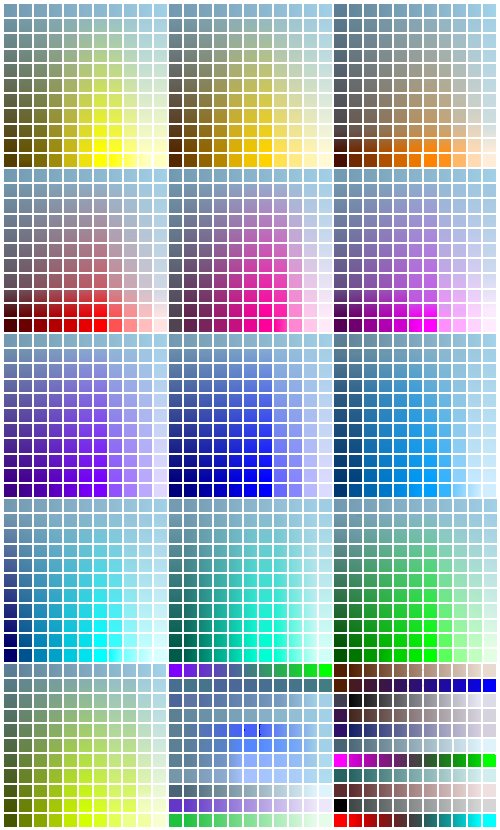
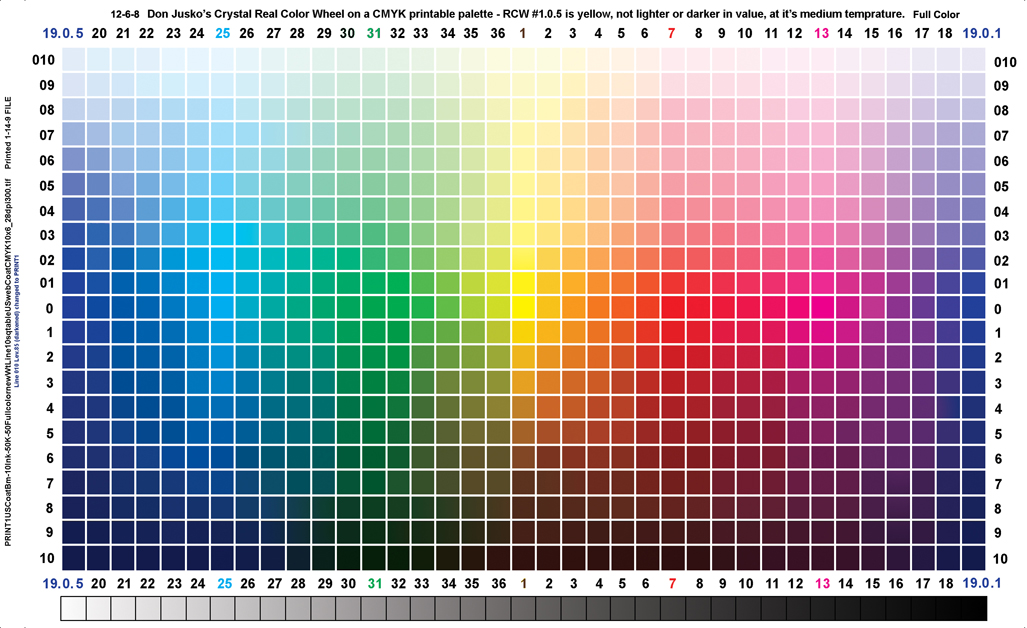
In this table chart of numbers the crystal matching colorwheel darkens yellow to warm brown while cyan darkens to cool ultramarine blue.

This chart is available as an RGB image and CMYK image in the Pen Palette Tiff Zip
SEND ME THE LINK.

 00   19   20   21   22   23   24   25   26   27   28   29   30   31   32   33   34   35   36   01   02   03   04   05   06   07   08   09   10   11   12   13   14   15   16   17   18   19 
 01                                                                                                                                                     
 02                                                                                                                                                     
 03                                                                                                                                                     
 04                                                                                                                                                     
 05                                                                                                                                                     
 06                                                                                                                                                     
 07                                                                                                                                                     
 08                                                                                                                                                     
 09                                                                                                                                                     
 10                                                                                                                                                     

The transparent primary color Yellow in pigments can shade to either a yellow-green Cool Dark, like in the RGB/YMC light system or to a red Warm Dark, like my color wheel has it for pigments. The transparent color pigment yellow must be on the warm side for the artist to mix it with any other warm color. Adding a cool yellow-green pigment to a warm yellow color would lessen the intensity of the yellow and make it dirty.

Yellow to black in the RGB is very similar to yellow-green's dark in both the RGB and CMYK the colorwheel.
The Real Colour Wheel (RCW), is different. Yellow goes to Red's warm dark brown like in nature,
not green's cool dark which is made by subtracting light.
The Titanium crystal has the RCW colors from yellow to brown to blue. Rutile crystal link


ELECTROMAGNETIC SPECTRUM COLOR CHART (EM) 7-25-8

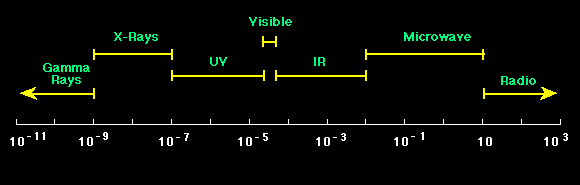
Real Color Wheel Electromagnetic (EM) Spectrum Color Chart is very accurate and measured in Nanometers,
1,000,000,000 nm to 1 meter.
Here is how to check it for color accuracy. Open the downloaded 600 ppi EM spectrum chart and enlarge it 200%, (that's really big) and read the color just above or below the color's dot with your color picker. Read this color in an RGB color wheel like Adobe's or the RGB Real Color Wheel. For the less saturated colors like yellow and orange move the slide to the full hue. This small 72 dpi web image has a Twentieth Anniversary Macintosh profile. The download 600 ppi tif has an sRGB IEC61966-2.1 profile.

Real Color Wheel Electromagnetic Spectrum Type
(Shortest Wavelengths) Gama Rays - X-Rays - UV - (Violet)- VISIBLE COLORS -(Red) - IR - Microwave - Radio (Longest Wavelengths)
Violet, short wave length, high frequency, high energy.                                Red, long wavelength, low frequency, low energy, radio waves.

Real Color Wheel Electromagnetic Spectrum (EM) color chart
EM spectrums can be read both backward or forward.
Red could be on the left because it has the lowest frequency 400,000,000 MHz
Red could be on the right because it has the longest wave length at 700 nm.
Blue could be on the left because it has the shortest wave length per second)
Blue could be on the right because it has the highest frequency at 700,000,000 MHz

If you would like the link to this large 600 dpi tif EM image in a Zip file ask for one by Email.
Electromagnetic Spectrum Chart 600 ppi by Real Color Wheel - Email
If you want more information about the electromagnetic spectrum it's on my rainbow page.


PRINTER AND PLOTTER ARTISTS, DON'T MISS THIS RGB-CMYK PRINTING COMPARISON.

The RCW Real Color Wheel is also the Crystal Real Color Wheel. It shows the colors of these elements in there natural progression as they get darker. For instance, crystal oxides containing iron, go from yellow to brown, orange to brown or red to brown.

Light's RGB colorwheel is inaccurate for plotting pigments or for the artist to use as a color wheel in the field. Ultramarine blue must be opposite yellow and plot opposite yellow, like on this wheel. It is just as accurate as the simple RGB positioning of pure colors, only better because it includes the correct darker path colors.

A new opaque Irgazine Yellow is a perfect warm darker yellow, 36RCW#1.6 while the new Bismuth Yellow is the bright full chroma RCW#1.0 The Irgazine Yellow has a very slight dual-tonality and will mix with its complement ultramarine blue to a dark.

Look at Real Color Wheel's #36.0, Yellow-green, and compare it to the primary path to dark for Yellow on the RGB wheel. They look the same even though they are two different colors. There is no warm yellow path to dark in the RGB, only the cool Yellow-green path. On the RCW, I properly put them side-by-side. I use the warm path of yellow as the path of pure primary Yellow and the cool path as Yellow-green's path because this is exactly how the pigment crystals darken. Dual-toned Irgazine Green is a transparent Yellow-green and it mixes a neutral-dark with Dioxzine Purple.

Here are some crystals that could interest the artist since crystals are pigments and chemicals are made with the same elements.

The Calcite crystal, [CaCo3], makes the perfect Cyan color with the Copper element in the Iceland Spar Crystal which changes color when viewed from different directions (PLEOCHROISM) to the color Ultramarine Blue. The Iceland Spar's copper content causes the color to appear in a span of colors from cyan to ultramarine blue depending on your viewing position to it.
Yellow in crystals is made with Iron, Magenta is the Sphaerocobaltite Pink Calcite Crystal made with allochromatic Cobalt. The Calcite Crystal is also a natural polarizing filter.
Quartz, [Si02], Iron Rose Quartz and Manganese Amethyst both touch on the Magenta color.
Copper makes Green to Cyan in the Chalcedony crystal and its opposite color in the Red Carnelian crystal. Allochromatic Nickel makes a cool Yellow in the Chrysoprase crystal, added Iron it makes a warm yellow to orange in the Citrine Quartz Crystal.
Iron will make all three primary colors in the crystal Corundum, plus making the secondary colors Red, Ult. Blue and Green. The Red and Green have added Chromium to the crystal.

For the chemical colors and their color paths go here.


Here are some permanent chemical pigments used in oil, water, fresco and acrylic paints today.
Note that Transparent Indian Yellow and translucent Gamboge are synthetic hue/color names,
these colors as "genuine" pigments are not available or used today.

PERMANENT TRANSPARENT YELLOWS

7-10-9, Dual-toned Indian Yellow color chip images, new window.

DUAL-TONED INDIAN YELLOWS:

Yellow-Brown-Oxide hue to Lemon Yellow, PY:150 (Nickel Azo Brown - Lemon O.H.)
Yellow-Orange to Yellow, PY:153 Org/s, Dioxine Nickel Complex, BEST OIL BASED
Yellow-Orange to Yellow, PY:100 Tartrazine, BEST BRIGHT YELLOW, GLAZE, WATER-BASED, for ink, fresco, acrylics and watercolors.
Orange to Yellow, PY:95 Azo Condensation w/ PR:101 Syn Iron Oxide (Indian Yellow - Brown Extra O.H.)
*PR:101 Iron Oxide is not dual-toned by itself.
Yellow-Green-Oxide hue to Yellow, PY:153 Org/s Dioxine Nickel Complex w/ PY:129 Azo methine copper complex (Indian Yellow-Green Lake Extra OH)
Yellow-Brown-Oxide hue to Yellow, PY:150 Dioxine Nickel Complex (Zecchi Syn Indian Yellow) dry pigment
Red-Brown to yellow, PY:153 Org/s Dioxine Nickel Complex w/ Yellow Oxide PY42 (Indian Yellow Brown Lake Extra OH)
*PY42 Iron Oxide is not dual-toned by itself (Transparent Oxide-Yellow Lake OH)
Red-Orange to Yellow, PY:153 Org/s Dioxine Nickel Complex w/ PY:10 Isoindolin, Isoindolinone and Isoindoline are not transparent (Indian Yellow-Orange Lake Extra OH)
Red to Yellow, PY:153 Dioxine Nickel Complex w/ Quinacridone (Old Holland Red Gold Lake OH)
Yellow-Ocher Gr/s hue to Yellow, PY:129 Azo methine copper complex w/ Azo Condensation PY:95 (Indian Yellow-Green Extra OH)

Dual-toned Indian Yellow-Greens;
Green to Yellow-Green, PY:150 Gr/s Nickel Azomethine w/ PG36 Y/s Copper Complex w/ PY3 Hansa Yellow (Green Gold by Golden)
Green-Orange hue to Yellow-Green, PY:129 Azo methine copper complex (Old Holland Green Gold)
Green-Oxide hue to Yellow-Green, PY:117 Azo methine copper complex (Genuine Golden Green by Mussini)

IMPORTANT COLORS

Yellow-Brown-Oxide hue to Lemon Yellow, PY150 Nickel Azo Complex (Nickel Azo Brown - Lemon by O.H.)
Yellow-Orange to Lemon Yellow, PY:153 Org/s, Dioxine Nickel Complex by O.H.
PR122 quinacridone = Magenta
PV23.1r carbazole dioxazine = Purple
PV23 dioxazine nickel complex = Permanent Violet Blueish transparent secondary blue
PB60 anthraquinone and indanthrone = Blue Deep to Turquoise
PB15.3 copper phthalocyanine (BEST) and PB33 manganese Barium Manganate= Cyan (Thalo Blue and Manganese Blue transparents)
PB7 Chlorinated copper phthalocyanine = Turquoise to Green
PY83 stable di-arylide + PG7 chlorinated copper phthalocyanine = Sap Green Yellow/Side
PY83 stable di-arylide HR + PG7 chlorinated copper phthalocyanine + PO43 perinone orange = Sap Green Orange/Side
2002, Liquitex has some nice new dual-toned transparent colors, Acra Gold = yellow to brown, darker than Indian Yellow Brown Side. A Burnt Orange that's brown to orange and Van Dyke Brown, a brown to red color.
2006, Golden Artist Colors added Indian Yellow Golden Hue, Arylide Yellow PY7, Nickel Complex Azo PY150 and Quinacridone PR206, transparent, very nice Indian yellow. Also added, a green/brown Indian yellow hue called Nickel Azo Yellow, PY150.

TODAY'S 7-23-8 TRANSLUCENT TO OPAQUE PALETTE PIGMENTS
Used in addition to the transparent primary and secondary pigments for their opaqueness and brilliance.

PY35 cadmium Zinc sulfide = Cadmium Yellow Lemon
PY37 cadmium sulfide = Cadmium Yellow Light, Medium
PO20 cadmium sulfo-selenide = Cadmium Orange
PR108 cadmium seleno-sulfide = Cadmium Red Light, Medium
PR88 Thioindagoid Red, a perfect opaque Red.
PR101 synthetic red iron oxide = Red Oxide
PY42 synthetic yellow iron oxide = Yellow Oxide
PBr7 natural iron oxide, raw and calcined = Sienna and Umber
PB29 silica, aluminum, sulphur complex = Ultramarine Blue
PB28 oxides of cobalt and aluminum = Cobalt Blue
PG17 anhydrous chromium senquioxide = Chromium Oxide Green
PY129 irgazine green = Transparent dual-toned green to yellow-green


HOW TO USE THE REAL COLOR WHEEL TO MAKE NEUTRAL-DARKS

Yellow on top, read red right. #1 to #36, 10 degrees each color.

#1, to reach a dark neutral use the darkest form of yellow, orange or red (all of which are burnt umber) and mix it with its opposite color.
Red, raw umber, burnt umber with ultramarine blue, cobalt blue or cyan will mix neutral darks in any combination.
Darken an orange object by first adding red, then add raw sienna or burnt sienna or burnt umber depending on the color needed.
Burnt Sienna is a dark orange. Burnt umber is a darker orange.
Burnt Sienna with cobalt blue will make burnt umber.
Cadmium orange has twice as much opaque yellow in it than red does so you have to mix it with the orange in it's darker form (which is burnt umber) to reach a neutral dark.
Opaque cadmium orange and opaque cobalt blue will only make a neutral gray because orange is opaque with 3/4 yellow and 1/4 magenta, that amount of opaque yellow will prevent it from mixing to a really (dark) dark neutral, it makes a neutral gray instead.
Burnt umber is the darkest orange, burnt umber and cobalt blue will mix neutral dark which can be lightened to a neutral gray, all neutral darks can be lightened to neutral gray.
Cadmium red light will mix a red oxide hue or a burnt umber hue with transparent cyan.
Cadmium red light will mix a neutral dark with transparent cyan.
Cadmium red light with magenta PR:122 will make a cadmium red medium.

To darken a yellow object first use the mass-tone of transparent yellow, from that point add the graduated color oxides like yellow ocher light, medium or dark to brown oxide. Green oxides and umbers are sometimes needed.
Adding blue to any yellow color less dark than raw or burnt umber brings the color to a green side which is not normally natural looking.
Brown with a varying amount of blue works best. Add that mixture to any yellow oxide color to darken it.
Orange will darken farther than bt. Sienna with the addition of its opposite color cobalt blue which will make a brown.
Orange darkens first with the addition of red. Red lightens with the addition of orange.
Red darkens with its opposite color cyan and makes the color red oxide, more cyan will mix to burnt umber or the neutral dark.

Cyan first darkens to blue, like the sky, cyan at the horizon and ult/royal blue at the azimuth.
Cyan and red darken neutral.
Blue and red oxide or brown (both are dark reds) mix a dark neutral.

The rest of this color wheels colors will darken by adding the opposite color until it reaches neutral dark.
All Greens darken with magenta, all magentas darken with green.
All yellow-greens darken with blue-purple, all blue-purples darken with transparent yellow-green.
Transparent Indian yellow Org/s PY:153 can be an orange hue in its mass-tone or a cad yellow light hue in its tint. Nickel works best in oil.
Transparent Indian yellow Br/s PY:150 can be a yellow oxide hue in its mass-tone or a cad yellow light hue in its tint. Nickel works best in oil.

Therefore, anyone working with pigments can reliably find truly opposite colors, which will always mix to a neutral dark without using black pigment.
An artist can create the shadowed areas of any colored object by combining that color with its opposite as found on this colorwheel.
This mixture will match nature every time, unlike the results obtained using any other colorwheel.
It works with the same colors in both pigment and light, the first color wheel ever to do that. Neutral is black in pigments, white in light.  


OIL PIGMENT PALETTE

There is a space for each of these colors on my 37 COLOR OIL PALETTE although I may not fill them all every time I paint.

White is in the middle of the palette. The top of my palette on the left is Dioxazine Purple, Ultramarine Blue, Cobalt Blue, Thalo Blue, Turquoise, Opaque Green and Thalo Green Y/s on the right. 

The left side goes from Dioxazine Purple to Burnt Umber, Bt. Sienna, Red Oxide, Yellow Ochre, Naples Yellow (or lead-tin Yellow) to Quinacridone Magenta at the bottom. 

The bottom row of colors is Quinacridone Magenta, Rembrandt Rose, Cad Red, Cadmium Orange, Indian Yellow Golden, Cadmium Yellow Medium, Cadmium Yellow Light, Cadmium Yellow Pale, Lead Yellow Lemon is in the bottom right corner of the palette. 

The right side is from Thalo Green Y/s on the top, than Permanent Green Light, Green Gold, Yellow-Green Transparent & Opaque with Yellow Light at the bottom. 

I keep all 37 of these oil pigments below on hand with me, they all have their special color and pigment properties.

00. Mussini Zinc Yellow,   01. Bellini Lemon Yellow,   02. YYYY, Grumbacher Cadmium Barium Yellow Pale,   02a. YYYY, Mussini Cadmium Yellow Lemon,   04. Old Holland Gamboge Lake Extra,   05. Schmincke Mussini Cadmium Yellow Middle,   06, Old Holland Indian Yellow-Orange Lake Extra,   06a. Old Holland Indian Yellow Brown Lake Extra,   07. YYYM, Mussini Cadmium Orange,   08. Rembrandt Chinese Vermilion Extra,   09. YYMM, Cadmium Red Medium,   10, YMMM, Rembrandt Rose,   11. MMMM, Daniel Smith Quinacridone PR122 Magenta,   12. MMMM, Bocour, New York, Cobalt Violet Phosphate, removed   13. MMMC, Liquitex Carbazole Dioxazine Purple,   14. Grumbacher Dioxazine Purple,   15. Ultramarine Violet,   16. MMCC, Blocks French Ultramarine Blue,   17. Mussini Ultramarine Light,   18. Mussini Cobalt Blue Light,   19. CCCC, Grumbacher Thalo Blue PB15.3,   20. CCCY, Rembrandt Blue Green,   21. CCYY, Mussini Phthalo Green B/s,   22. Mussini Opaque Green Light,   23. Grumbacher Thalo Green Yellow/Side,   24. Mussini Permanent Green Light,   25. Winsor and Newton Sap Green permanent,   26. CYYY, Old Holland Yellow-Green Organic Opaque,   27. Mussini Naples Yellow Light,   27a. Mussini Naples Yellow Deep,   28. Mussini Yellow Raw Ocher,   29. Mussini Translucent Yellow Oxide,   30. Rembrandt or Mussini Asphaltum,   31. Mussini Raw Umber,   32. Mussini Burnt Umber,   33. Mussini Burnt Sienna,   34. Blocks Venetian Red,   35, Rembrandt Chromium Green Oxide,   36. Grumbacher Green Earth,   37. Mussini Genuine Golden Green, 


36 RCW OIL COLORS ON THE REAL COLOR WHEEL

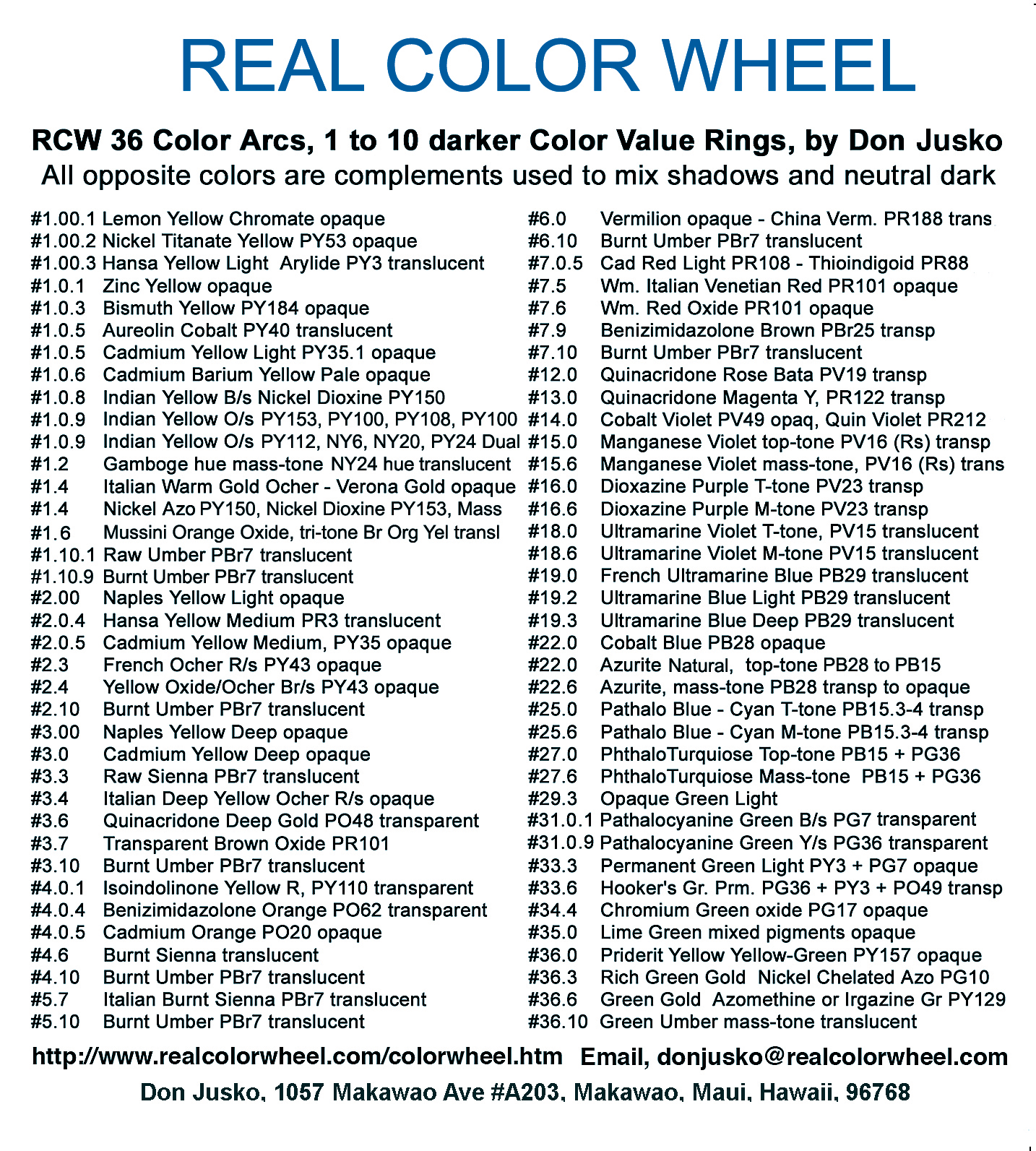
RCW#1.00.1, Chrome Yellow Light, Lead Chromate, Opaque PY34
RCW#1.00.2, Nickel Titanate Yellow, PY53, Opaque
RCW#1.00.3, Hansa Yellow = Monoazo Yellow, PY74, Translucent
RCW#1.0.1, Yellow Light Hansa = Arylamide, PY3, Translucent
RCW#1.0.1, Cadmium Zinc Sulfide, PY35, Opaque
RCW#1.0.2, Cadmium Lemon, PY35, Opaque
RCW#1.0.3, Bismuth Yellow, PY184. Opaque
RCW#1.0.5, Aureolin = Potassium Cobaltinitrite, PY40, Translucent
RCW#1.2, Indian Yellow = Anthrapyrimidine, PY108, Translucent.
RCW#1.4, Warm Gold Ocher = Azo Yellow + Monoazo Yellow, PY151, Translucent
RCW#1.6, Indian Yellow-Brown Lake Extra = Dioxine Nickel Complex + Synthetic Iron Oxide, PY150 + PY42, Transparent.
RCW#1.6.1, Indian Yellow Gr/s = Nickel Chelated Azo, PG10F, Transparent.
RCW#1.6.5, Indian Yellow-Orange Lake Extra, Dioxine Nickel Complex + Isoindoline, PY153 + PR260, Transparent
RCW#1.10.1, Raw Umber Brown = Natural Earth = Hydrated Iron Oxide, PBr7 or PY42, Translucent
RCW#1.10.9, Burnt Umber Brown = Natural Earth = Hydrated Iron Oxide, PBr7, Translucent
RCW#2.01, Naples Yellow = Titanium Dioxide + Rutile-Nickel-Tin-Titanium or Chromium-Antimony or Titanium Yellow, PW6, PY53, PBr24, Opaque
RCW#2.0, Chrome Yellow Orange = Lead Chromate, PY34, Opaque
RCW#2.4, Yellow Ochre = Natural Hydrated Iron Oxide, PY43, Opaque
RCW#2.10, Burnt Umber Brown = Natural Earth = Hydrated Iron Oxide, PBr7, Translucent
RCW#3.01, Naples Yellow Deep = Lead Antimonate, PY41, Opaque
RCW#3.0, Cadmium Yellow Deep, Opaque
RCW#3.3, Raw Sienna = Natural Iron Oxide, PBr7, Opaque
RCW#3.4, Italian Deep yellow Ocher R/s, Opaque
RCW#3.6, Quinacridone Deep Gold PO48, Transparent
RCW#3.7, Brown Oxide, PR101, Transparent
RCW#3.10, Burnt Umber Brown = Natural Earth = Hydrated Iron Oxide, PBr7, Translucent
RCW#4.0.4, Benzimidazolone Orange, PO62, Transparent
RCW#4.0.5, Cadmium Orange = Cadmium Sulfo-Selenide, PO20, Opaque
RCW#4.6, Burnt Sienna, PBr7, Translucent
RCW#4.10, Burnt Umber Brown = Natural Earth = Hydrated Iron Oxide, PBr7, Translucent
RCW#5.7, Italian burnt Sienna, PBr7, Translucent
RCW#5.10, Burnt Umber Brown = Natural Earth = Hydrated Iron Oxide, PBr7, Translucent
RCW#6, Chinese Vermilion = Mercury Sulfide, Translucent
RCW#6 Vermilion Extra = Isoindolindon, PR260, Translucent
RCW#6.10, Burnt Umber Brown = Natural Earth = Hydrated Iron Oxide, PBr7, Translucent
RCW#7.0.5 Thioindagoid Red, PR88, Opaque
RCW#7.0.5 Cadmium Red Light Red, PR108, Opaque
RCW#7.6, Light Red Oxide & Venetian Red Warm, Synthetic Iron Oxide, PR101, Opaque
RCW#8.0, Irgazine Red, PR254, Opaque
RCW#10.01, Light Portrait Pink = Naphthol Red AS-D + Titanium White + Diarylide Yellow, PR122, PW6, PY83, Opaque
RCW#10.0, Naphthol Crimson = Naphthol AS, PR170, Translucent
RCW#12.01, Light Magenta = Naphthol AS + Quinacridone Violet + Titanium Dioxide + Zinc Oxide, PR188, PR122, PW6, Opaque
RCW#12.0, Permanent Rose = Quinacridone, PV19, Transparent
RCW#13.0, Quinacridone Magenta = PR122, Transparent Magenta
RCW#14.0, Cobalt Violet, PV49, Opaque Cool Magenta. Opaque
RCW#14.0, Cobalt Violet = Cobalt Phosphate, PV14, Transparent Cool Magenta
RCW#15.0, Manganese Violet, PV23 R/s, Top-tone, Transparent
RCW#15.6, Manganese Violet, PV23 R/s, Mass-tone, Transparent
RCW#16.0, Dioxazine Purple or Carbazole Dioxazine, PV23, Top-tone, Transparent
RCW#16.6, Dioxazine Purple or Carbazole Dioxazine, PV23, Mass-tone, Transparent
RCW#18.0, Ultramarine Violet = Alumosilicate of Sodium, PV15, Top-tone, Transparent
RCW#18.6, Ultramarine Violet = Alumosilicate of Sodium, PV15, Mass-tone, Transparent
RCW#19.01.1, King's Blue Deep = Zinc Oxide + Titanium Dioxide Rutile + Synthetic Ultramarine, PB29, PW4, PW6, PB29, Opaque
RCW#19.01.5, Light Blue Violet + Ultramarine Blue + Titanium Dioxide, PB29, PW6, Opaque
RCW#19.0.5, French Ultramarine Blue, PB29, Translucent
RCW#19.2.5, Ultramarine Blue Light, PB29, Translucent
RCW#19.3.5, Ultramarine Blue Deep = Complex Silicate of Sodium and Aluminum with Sulfur, PB29, Translucent
RCW#22.0, Cobalt Blue = Oxides of Cobalt and Aluminum, PB28, Opaque
RCW#25.0, Pathalocyanine / Phthalo / Thalo = Cyan Blue, PB15.3, Transparent.
RCW#25.0, Cerulean Blue Opaque = Oxides of Cobalt and Chromium, PB-36. Opaque
RCW#25.0, Manganese Blue by O.H. Cyan Bluish transparent PB33, new 2008.
RCW#25.6, Thalo Blue / Phthalo Blue / Cyan = Pathalocyanine, Mass-tone
RCW#27.01, Phthalo Turquoise = Pathalocyanine, PB15.3 + PG36, Top-tone
RCW#27.6, PhthaloTurquoise = Pathalocyanine, PB15.3 + PG36, Mass-tone
RCW#28.3, Bright Aqua Green = Phthalocyanine Green + Phthalocyanine Blue + Titanium Dioxide, PG7, PB15.3, PW6, Opaque
RCW#29.3, Opaque Green Light = Phthalocyanine Green + Monoazo Yellow + Cobalt-Titanium-Nickel-Zinc-Aluminum-Oxide. Opaque
RCW#31.0.1, Phthalo Green, B/s = Phthalocyanine, PG7, Transparent
RCW#31.01.9, Emerald Green Syn. + Brominated Copper Phthalocyanine + Titanium Dioxide, PG36, PW6, Opaque
RCW#31.0.9, Phthalo Green Y/s = Phthalocyanine, PG36, Transparent
RCW#33.3, Permanent Green Light = Phthalo Green + Monoazo Yellow, PG-7, PY-3, Opaque
RCW#33.6, Hooker's Green Permanent, PG36 + PY3 + PO49, Transparent
RCW#34.6, Chrome Oxide Green, Chrome Oxide, PG-17, Opaque
RCW#35.0, Yellow Green Organic, Opaque
RCW#35.0.6, Sap Green = Arylamide Yellow GX + Phthalocyanine Green + Red Oxide, PY73, PG7, PR101, Opaque
RCW#36.0.1, Priderit Yellow PY157, Yellow-green, Opaque
RCW#36.0, Thalo Yellow Green = Chlorinated Copper Phthalocyanine + Arylide Yellow 10G + Zinc Oxide, Opaque
RCW#36.3, Green Gold + Nickel Chelated Azo, PG10, Translucent
RCW#36.6, Indian Yellow-Green Extra = Dioxine Nickel Complex + Methin Copper Complex, PY153, PY129, Transparent
RCW#36.6, Green Gold = Azomethine Copper Complex, PY129, Transparent
RCW#36.6, Irgazine green, PY129, Translucent
RCW#36.10, Green Umber, Br7, Translucent


Tubed Pigment Colors as the page background and hexadecimal codes, Link.

DESCRIBING THIS LINK

I think a spectroscope of dried pigment color would show all colors to be impure but this can't always be shown on the web. The percentage of CMYK was from a mathematically printed chart and matched to the tube colors by eye.

I also matched the dried chip color to the computer by eye. It's close enough to paint with a computer tablet, for comercial artwork, interior design, etc. and compare the relationships of similar colors in pigments. Each color's first number relates to its position on the 36 color Real Color Wheel.
Yellow is the color numbered #1.0, the full designation for yellow is 36RCW#1.0.5.
The (dot) second number locates the color in each wedge as it gets darker or lighter, matching crystals. "0" is the pure color.
The third diget, .5, is in the middle of the warm to cool veritable numbered from 1 to 9.
A zero and a number (two digets) as the second number is a yellow tint, (#1.01 to #1.09). #1.09 is a very light yellow tint.
The number (#1.1) is the first darker version of yellow, (#1.9) is a very dark yellow brown/side.
Opposite complement pigments mix dark shadow colors just as nature makes darker and lighter shadows on any local-color object.
#1.9 (dark yellow) plus its opposite, #19.0 to #19.9 (French blue to deep blue) together mix a dark neutral.
The Rutile crystal shows progressive color, a tint of yellow, full yellow, half-yellows, dark brown, blue and black.
Titanium Crystal, Rutile 


Red, Blue, BlueViolet, Brown, FireBrick, YellowGreen, Green, DarkGreen, Red, Yellow, Gold, Magenta, LightSkyBlue, etc.

Top-tone is adding White to the color. Under-tone is adding clear, like water or oil. Mass-tone is thick out of the tube pigment. Click the radio button to change the background to the matching tube color.

THAT LINK GIVES IT ALL
Here's an example;
#1.0.2, Mussini Cadmium Yellow Pale, a slightly cool Yellow. #"FFFA43", R=255 G250 B=067
Opposite color = 19.0.5, Blockx French Ultramarine Blue, translucent. #"150036", R=21, G=0, B=36
To mix a dark neutral, use the darkest form of opaque yellow, #1.10.9, Mussini Burnt Umber and mix it 1:1 with its opposite color, Ultramarine Blue.
Do that with each of the colors in this arc #1 to make a neutral dark or neutral gray.


The RGB Aerial Palette for 10 Concentric Rings.

Go to this chart page to see how this digital Aerial Palette is used.

Aerial Palette


   ARTISTS' 36 REAL COLOR WHEEL

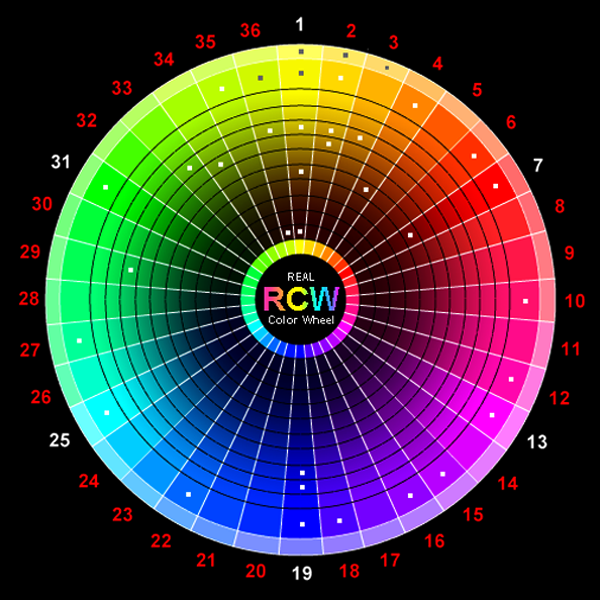
All dots are clickable links to each pigment's description page.
The center links to the photo pigment color chip chart pigment page. Pigment artists, don't miss it!
Real Color Wheels are 360, 36, 12, 6 or 3 colors.

The color "arcs" or "wedges" of color are numbered from 1 to 36, the 360RCW shows 360 colors.)

#00. Outer tint rings are two digits, they are lighter pigments and tinted hues of this full color.
#0. All wedges main colors are digit zero, that's 100% full chroma for opaque pigments and a 50% top-tone tint for transparent pigments.
#1.01 The first tint of the 1st color yellow arc/wedge, two digits.
#1.0 the full chroma opaque yellow or a 50% tint of a transparent Indian yellow, both are in Block 0.
#1.0.1 the coolest of 9 colors within that 10º arc/wedge of the 36RCW and VariableRCW.
#1.1 the first dark of 10 divisions to dark of this first color yellow.
#1.2 the second dark
#1.3 the third dark
#1.4 the forth dark, Gold Ocher opaque or mass-tone Indian Yellow PY150.
#1.5 the fifth dark of 10 divisions to dark of this first color, also the mass-color of some transparent pigments
#1.6 the sixth dark of 10 divisions to dark of this first color, also the mass-color of some transparent pigments
#1.7 the seventh dark of 10 divisions to dark of this first color.
#1.8 the eighth dark of 10 divisions to dark of this first color.
#1.9 the ninth dark of 10 divisions to dark of this first color.
#1.10 the tenth dark, 10% intensity of the 1st pure-color.

C l i c k a b l e  A r t i s t s  R e a l  C o l o r  W h e e l :  f i n d  m a t c h i n g  p i g m e n t s
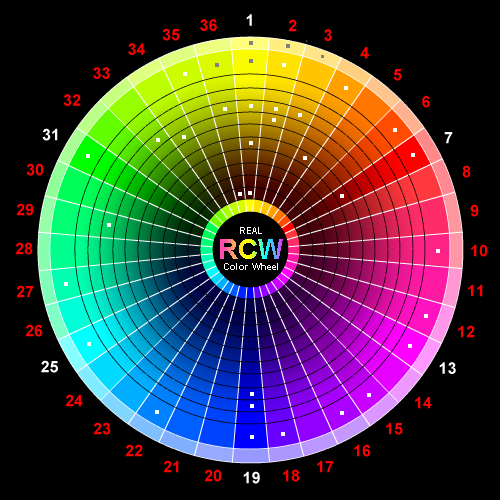
Lead Yellow, cool opaque Naples Yellow Light Naples Yellow Deep Acrylic Vivid lime Green, Oil Yellow Green Opaque Brilliant Yellow Green, translucent in acrylics Cadmium Yellow Cadmium Yellow Medium Cadmium Orange, opaque Green Gold, Transparent Indian Yellow-Orange Lake Extra Yellow Raw Ocher, Opaque Translucent Yellow Oxide Chinese Vermilion Extra, translucent Permanent Green light Chromium Green Oxide Indian Yellow-Brown Transparent Burnt Sienna, translucent Cadmium Red Light-Medium, Opaque Thalo Green, transparent Raw Umber, translucent Burnt Umber, translucent Venetian Red Oxide, Warm, Opaque Opaque Green Light Pigment Photo Chip Chart Rembrandt Rose, Translucent Turquoise Blue-Green, transparent Quinacridone Magenta, Warm Thalo Blue Cyan, Transparent Cobalt Magenta, Cool Ultramarine Blue, Translucent Ultramarine Blue Light Manganese Violet Cobalt Blue French Ultramarine Blue Purple, Transparent Raw Sienna, translucent Ultramarine Violet


UNDERSTANDING RCW NOTATIONS

( RCW#1.wedge .block .relative temperature )
The RCW logo includes the small, multicolored reference ring.


RING NOTATION
Any RCW can be seen as a set of twelve concentric rings, with the RCW logo in the center, comprised of blocks, these concentric rings intersect with all wedges.  The ring of pure colors is called Ring "0". Outside of Ring 0 lie the what can be referred to as the double digit "outer tint" rings. On the RCW above, there is only one tint, the "50% tint" ring. Similarly, inside Ring 0 lie the "inner" rings. These are the darker valued rings. 

The main ring represents either the full-chroma (100%) opaque pigment, or a 50% top-tone tint of darker transparent pigment. All of these colors are indicated by appending from ".1" to ".9" to the end of its wedge number. So, pure yellow is the middle of the 9º Variable RCW and is written as 36RCW#1.0.5. Cooler would be #1.0.1, warmer would be #1.0.9.

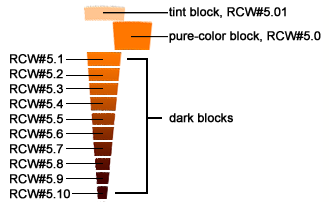
This RCW is made up of thirty-six 10º "wedges," (wedge-shaped stacks of "blocks,") which are arranged top to bottom and side-by-side, around the RCW logo. A wedge depicts specific intensities or values of a single color. Darker versions lie below and tinted versions lay above the pure-color block zero.

10º WEDGE-ARC-PIE NOTATION
The primary-color wedges are the yellow, magenta, and cyan wedges, RCW#1, RCW#13, and RCW#25. The secondary-color wedges are the Red, Blue, and Green wedges, RCW#7, RCW#19, and RCW#31.

BLOCK NOTATION
Indicates a block's position in the wedge in relation to the pure-color "0" block. Any block depicts a specific intensity of its wedge's pure color. The pure-color block is denoted by appending the single digit ".0" to its wedge number. Below this block, are the "darker" blocks. They show how the pure color looks darker as it gets mixed, (in 10% increments) with its true complement, the pure color of the opposite wedge. Except for bright yellow, use yellow's darker opaque or transparent brown to mix neutral-dark. The transparent dark brown to bright yellow is available in the Japanese auto industry, I saw a picture of the car sprayed with it.
Above the pure-color block, are "tint" blocks. This RCW has only one, showing the pure color as lightened 50/50 with thinner if the color is transparent, or with white if the color is opaque.  This first tint-block is denoted by appending a double digit ".01" to the wedge number. In the case of multiple tint-blocks, they would be denoted by appending, ".02", ".03", etc. as they get further from the pure color.
Note: The dark blocks, five and six, depict the mass-tones of transparent dual-toned pigments. Other dark blocks in this wedge show the mass-tone-related opaque oxides.

RELATIVE TEMPERATURE NOTATION
Each ring of every color is solid in this printed 36 color wheel, it represents one or more pigments. The Real Color Wheel is also a 360 color wheel with a different color in each degree of the circle. It is also a 3, 6, or 12 color wheel.
A color's relative temperature is how cool or warm it is in that 10º color. Denote relative temperature using nine color degrees of spectrum color in each wedge-arc-pie. To read color a wedge spectrum number rotate it to the top viewing position. Many wedges have one or more pigments of relative temperature in it, indicated by appending ".1 to .9" in its block number. "RCW#1.0.1", is closer to the left color wedge, so it would be a relatively cooler color of yellow. "RCW#1.0.9" is closer to the right color wedge, a relatively warmer color. "RCW#1.0.5" being in the middle of this 10º wedges spectrum, it represents this center degree of color for the whole 10 degrees. This solid color fills the full chroma block on the printed 36RCW#1.0.

REVIEW:
RCW#15 refers to a 10% wedge of color on this 36 Real Color Wheel.
RCW#15.0 refers to a pure mass-tone pigment.
RCW#15.0.1 to RCW#15.0.9 are 9 degrees of temperature. A zinc yellow is cooler than a cadmium yellow, both color temperatures are in the same pure color ring.
RCW#15.00 to RCW#15.09, the double digits numbers refer to tints of the pure color RCW#15.0.

detail


CYAN, RCW#25.0 (the mass-tone) darkens in intensity to RCW#25.8, dark blue. It's exactly the same as Ultramarine Blue's darkest blue RCW#19.8 Both cyan and blue add their complement color there to get to a neutral dark in two blocks. So Cyan and Blue use three mass-tone pigments to get to neutral dark, or three primaries.
Shadows on a cyan object include cyan and ultramarine blue which is cyan and 50:50 magenta.
Yellow RCW#1.0 darkens in intensity to RCW#1.10.5 brown using exactly the same color as Red's darkest red RCW#7.10 brownbefore any complement is added into it. That's why Rembrandt said yellow and red were simular.
Neither wedge uses the complement to get dark-neutral yet but the next block down would be black in both by adding 100% of each opposition color.
Shadows on a yellow object include degrees of ultramarine blue and brown, depending on the light conditions.
Beyond any dark Block#10 is Black. It can be easily made by mixing together the three primaries: Yellow PY:153 warm or yellow PY:150 cool, or PY:100 if you are using watercolors, added to Magenta PR:122 and Cyan PB:15. A neutral black can also be made by combining any complement or split-complement set of colors.

The color wedges from yellow to red and cyan to blue have this similar characteristic while the other colors are darkened with only their opposite color.
RCW#13.0 100% magenta + 100% green mix to make black. That is how 2/3's of this color wheel works, the whole colorwheel would work that way but we don't have the dark brown to yellow or dark blue to cyan pigments yet.
RCW#7 red makes the dark brown by adding its opposite color cyan. Cyan makes neutral darks 1:1 with red pigment before or after the dark blue is added. I wish some day this dark blue to cyan will be one transparent dual-toned pigment. I saw a really nice truck painted with it a few weeks ago, it was an amazing Japanese pigment that's not available for artists yet.

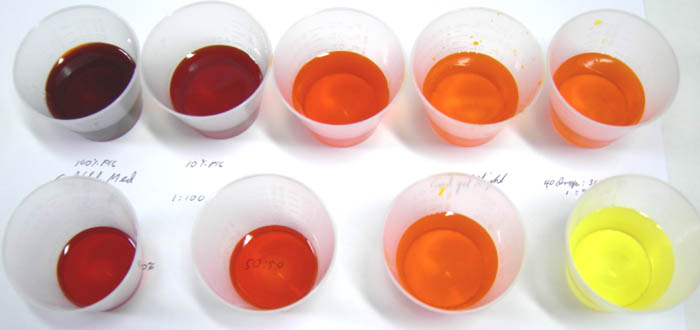
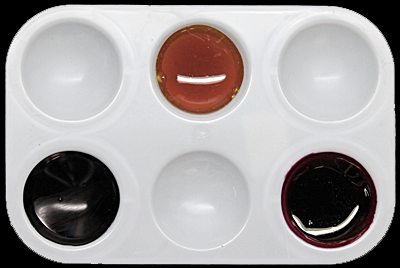
Yellow makes neutral-darks by using dark brown and its opposite color ultramarine blue. Here is a photo of the dark brown liquid (made from dry pigment) Tartrazine. Tartrazine is not a pigment for sale in tubes yet, but it should be. The photo is for proportions to use it as ink in my plotter. The third swatch from the bottom end is what I use in my yellow transparent ink.

Here is the permanent transparent ink color in my plotter, it's called Tartrazine Acid Yellow 23, an Azo pigment, PY:100.
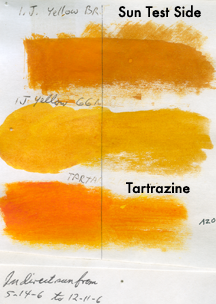
The photo is of a 7 month sun test on the dashboard of my van. I included a link to a larger image to show the faded out ball point date in the upper right corner as a reference.
This sun test shows that Tartrazine PY:100 is a permanent pigment. 7-31-9

   Transparent yellow printing

Order here. RCW Transparent Primary Water Color Palette with Tartrazine yellow Clear.
THIS IS WHAT TRANSPARENT INDIAN YELLOW SHOULD LOOK AND BEHAVE LIKE.

IT'S BETTER, CLEANER AND BRIGHTER THAN ANYTHING ON THE MARKET TODAY. 5-20-10


RCW#25 transparent cyan and opaque red RCW#7 are opposite colors. By using similarly-numbered blocks of these wedges to represent pairs of complements they will make neutral-darks when mixed.
2 parts cyan and 1 part of magenta make a hue of cobalt blue.
Cyan and Blue will mix the same neutral dark with the two opposite colors.
100 parts transparent cyan + 100 parts transparent magenta make Ultramarine Blue. 100 parts of RCW#19.0 Ultramarine Blue and 90 parts of Burnt Umber will make RCW#19.10 Dark Ultramarine Blue.
100 parts cyan + 50 parts magenta makes Cobalt Blue

36RCW#25, CYAN TO DARK BLUE matching the printed RCW

#25.0 cyan  = 40% mass-tone intensity in a clear media + 00% ult. blue.
Notice that the printed cyan is a 40% tint of transparent cyan, it's not the mass-tone of PB15.3.
#25.1 cyan hue = 60% intensity in a clear media + 0% ult. blue.
#25.2 cyan hue = 40% intensity in a clear media + 5% ult. blue = #19.0
#25.3 cyan hue =  50% intensity in a clear media + 10% blue #19.0
#25.3 cobalt hue = 60% intensity in a clear media + 40% blue #19.0
#25.4 cobalt hue =  50% intensity in a clear media + 50% blue #19.0
#25.5 blue hue = 40% intensity in a clear media + 60% blue #19.5
#25.6 dk blue = 30% intensity in a clear media + 70% dark blue #19.6
#25.7 dk blue = 20% intensity in a clear media + 80% dark blue #19.7
#25.8 dk blue = 10% intensity in a clear media + 90% dark blue #19.8
#25.9 dk blue = cyan 00% + 100% dark blue = #19.9
black = dark-neutral = 100 parts blue + 100 parts red's brown or yellow's brown (very close to the same color burnt umber)

36RCW#19, (FRENCH ULTRAMARINE) BLUE TO NEUTRAL DARK
Parts are different than percentages. 100 parts of of blue (100 teaspoons) and 10 parts brown (10 teaspoons) = 110 teaspoons = 100%

#19.0 = French Ultramarine Blue
#19.1 = Ult. Light = 75% Ult. Blue Light + 25% Ult. Blue Deep
#19.2 = Ult. Light = 50% Ult. Blue Light + 50% Ult. Blue Deep
#19.3 = Ult. Deep = 80% Ult. Blue Deep + 30% Ult. Blue Light
#19.4 = Ult. Deep = 90% Ult. Blue Deep + 10% Ult. Blue Light
#19.5 = 100% Ultramarine Blue Deep
#19.6 = 90% Ult. Blue Deep + 10% brown
#19.7 = 80%  Ult. Blue Deep + 20% brown
#19.8 = 70%  Ult. Blue Deep + 30% brown
#19.9 = 60% Ult. Blue Deep + 40% brown
#19.10 dk blue = 50% Ult. Blue Deep + 50% brown
Ultramarine Light will work if you don't have Ultramarine Blue Deep

36RCW#1, YELLOW TO DARK BROWN
Yellow is a family of related colors. Two transparent yellows, orange/side and brown/side (a yellow oxide hue) both go to bright yellow. Opaque iron oxides cover the whole range of yellow, umber's and ochers are oxides. Burnt brown, raw brown, French ocher, yellow ocher, gold ocher and many in between. Amberg yellow oxide is the brightest yellow ocher oxide. A great color run by the Iron element!

Hooray for Iron's opaques and Nickel Azo's transparent oils and Tartrazine Azo for water-based paints. Congratulations to the winners of the Yellow Color Award from the RCW. I know it's been done before by the Byzantine's in the Dark Ages durning their First Golden Age of Byzantine, Pictura Translucida paintings but these winning pigments are permanent and tested in buon fresco.

So there are many ways for yellow to reach brown when you include the transparent and opaque yellows plus the dual-toned transparent browns that tint to ochers and yellows.


ACCURATE SPLIT-COMPLEMENTS

The 36 "real color wheel" will give you accurate split complements. Between #1yellow and #19ultblue are eighteen 10° spaces on each side of the colorwheel. From one to nine colors on each side of the opposite color makes the designers' split complements. Expect perfection; it happens all the time in nature. "YELLOW AND BROWN ARE DIFFERENT DEGREES OF THE SAME COLOR". Earth colored with the the iron element traverses yellow, yellow ochers, red ochers, brown ochers and brown green ochers. The Nickel element makes the yellow to orange dual-toned transparent colors and yellow to ocher dual-toned transparent colors. Nickel Azo is from transparent or translucent yellow, orange and red. The Cadmium element can make a opaque light yellow-green, yellow, orange and red, always opaque. Lead makes yellow, orange, red, brown warm, brown cool, blue and cyan, always opaque. The Copper element will make opaque or transparent cyan including green and makes a red transparent crystal, the opposite color of cyan. Quinacridone is best making transparent magenta to transparent rose. The elements Iron, Magnesium and Carbon will also make all colors.

DON'T EAT THE PIGMENTS
Check a box of strawberry Nutri-Grain bars sold in America and youll notice that the treats
contain synthetic food dyes like Red 40, Yellow 6, and Blue 1. Shoppers on the other side of the
pond buying the same products, however, will see that their bars get their colors from
all-natural beet root, annatto, and paprika extract. As a consequence, the Kellogg Company,
Kraft, McDonalds and other American companies that do business in Europe use safe, natural
colorings there but harmful, synthetic petrochemicals here in the USA.


All About Color RCW Course  | Site Tree Index of all links  | gallery with tips 1  | 2  | 3  | 4  | 5  | 6  | 1st paintings with tips  | 50th  | 100th  | 150th  | 200th  | w/c paintings on location  | acrylic paintings on location  | alkyd paintings on location  | oil paintings on location  | fresco paintings on location  | paintings for sale  | coloring book examples  | location DVDs for sale  | color workshop gif/jpg  | children learning color  | rainbows  | coloring book  | making panel supports  | making mediums  | brushes that work  | my pigments  | oil palette map  | acrylic palette map  | self portraits  | 1881 paints  | learn perspective  | picturatranslucida  | cera colla wax  | painting waves  | painting with alkyd  | aerial perspective  | coloring page and palette  | compare brand colors  | permanent transparent colors  | large real color wheel charts  | Real Color Wheel  | match tube colors  | 6 complements make neutral dark  | 36 color chips mixing neutral dark  | aerial perspective palette  | human proportions and painting  | painting fresco  | wide format plotter  | links and awards  | biography  | testimonials | Wikihow/How to Use the Real Color Wheel | Wikihow/Construct an RCW Color Wheel 12 colors | latest work

Prismacolor pencils mounted on the Real Color Wheel
Teaching Color on The Gateway to 21st Century Skills

NEXT, Other Color Wheel
PREVIOUS, Tube Oil Colors matching the RCW

Real Color Wheel full course "All About Color"


Order this color course on CD, $35.00 includes a 5" RCW.
Order a 5"X5" Laminated Real Color Wheel with instructions $15.00

Painting on Location Join Painting on Location forum, show your location paintings.   Email  Don Jusko


Free printable Real Color Wheel, CYMK and RGB
Free RCW tif CMYK and RGB printable zips.