Painting on Location
by Donald A. Jusko

Graduated Color Blends in Fresco


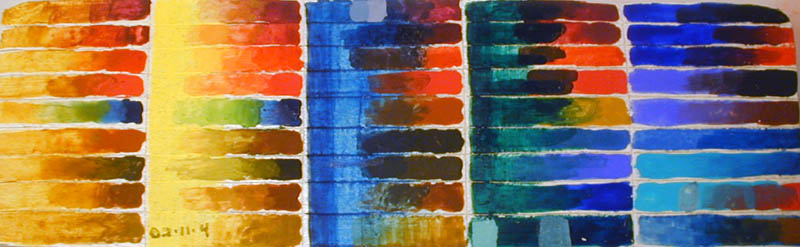
COLOR TEST CHART #5, 02-11-04

There are several ways to lighten color, today I want to get more carbonate forming on the surface. I'll start with one pigment and one lime putty, that should do it. That visually lightens the color about 10% while wet.

04-14-04, This is what I learned when the colors dry, a week later the color is 20 to 30% lighter. There is a big loss of contrast. Don't use lime cream or paste in dark colors. Paint the dark colors first so they have time to absorb.

Titanium white is very opaque, you get the tint color you mix wet when it's dry.
Zinc white is at least 4x weaker while wet.
Lime pigment is weaker yet when first applied.
Lime paste, cream and milk are the weakest.
How much will the lime paste 1:1 with pigment lighten it? This is my starting point. It will guarantee a carbonate layer. I've heard to add zinc white to this mix to bring the pigment up to it's final color, forget it. Titanium white will do it faster. The mortar was still not hard after 5 days. Steve said he saw it in 2 days by mixing all his pigments in lime paste but he is working in normal weather, it's very wet here. It might be just that simple. So why was lime pigment called the best white?

I scraped down the first dry rough coat to make it rough without any carbonate on top. Mortar: 1:1 marble meal and lime paste with 1/4 teaspoon of alum added. Two 1.5 inch diameter measuring cups 7/8ths of an inch high filled, covered an 8 1/4 x 2.5 inch brick with 1/4 inch of mortar.

After seeing how well the casein and pigment lettering secco bonded, I'm tempted to add 10% to the lime water for this fresco. I read where it was supposed to make painting sticky, it doesn't. Casein is very strong, don't use much of it.
Later I decided casein didn't help the mortar and alum did, it made it get harder, faster.

I sanded the trowels with a sponge sanding block to remove any rust and laid on the mortar. Popped out air bubbles with a pin as it was setting.

4 hours later it was still too wet, this brick holds too much water, I was using 2 year old lime putty, the brick is just too wet. I added another 25% of sand and doubled the alum, that brought the alum up to a level baby teaspoon. Still less the a half of one percent of the total mortar mixed. Now it spreads like room temperature butter and I can finish this tonight. I set the brick on a piece of absorbing paper.

color test #5

Lots of nice darks!
Quinacridone Red mixes with Cad yellow better than with Cad Red.
Indian yellow paints better with a little lime putty or lime milk.
The color are soaking in slowly, it's to easy to remove the last coat, bad for blending, I'm switching to pure lime water starting with the Thalo Blue column. Now I think it's the marble meal making it slower to absorb. The mortar is still soft enough to move with my finger so I know I'm not past the fresco time. Now I know it was the wet weather.
First Thalo Blue pure, then with lime putty.
A dry soft stippling goat hair brush helps blending.
Quinacridone Magenta has got to be reground between uses for it's best color.
Raw Umber is a lighter valued yellow brown, Burnt Umber is darker on the red side. Just like the RCW
Raw Sienna is as grainy as Pozzouli Red and Yellow Oxide.
Thalo Green needs alcohol to dissolve, let the alcohol evaporate and use limewater medium, add Quinacridone Magenta to make a good black.
Starting with Thalo Green and Cerulean I'm testing egg. Wow, it's like night and day, the blends are easy, the under coat doesn't pick up. Painting is fun again! I even put a stroke with titanium in the Thalo Green to Thalo Blue to see how close it comes to Cobalt Turquoise, which is still holding it's own in the lime jar test after twenty days. Egg leaves a high shine.
Once a stroke sets with egg you can't put another coat on top of it in fresco or secco. Don't use egg on buon fresco, just lime water. Later acrylic medium tested to be very good mixed with lime water.

15 days later, all of these pigments are lime safe.
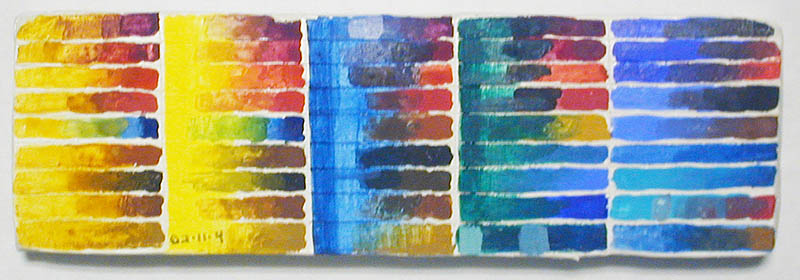
color test #5


NEXT FRESCO PAGE Alcohol, Ammonia, Egg, Casein
PREVIOUS FRESCO PAGE All Good Fresco Colors Chart
END PAGE End Page

JOIN THE PAINTING ON LOCATION WITH COLOR FORUM


Real Color Wheel Course  | Site Tree of all links  | gallery with tips 1  | 2  | 3  | 4  | 5  | 6  | 1st paintings with tips  | 50th  | 100th  | 150th  | 200th  | paintings for sale  | coloring book examples  | location video for sale  | color workshop gif/jpg  | children learning color  | rainbows  | coloring book  | making panel supports  | making mediums  | brushes that work  | my pigments  | oil palette map  | acrylic palette map  | self portraits  | 1881 paints  | learn perspective  | picturatranslucida  | painting waves  | painting with alkyd  | aerial perspective  | coloring page and palette  | compare brand colors  | permanent transparent colors  | large real color wheel charts  | Real Color Wheel  | match tube colors  | 6 complements making neutral dark  | 36 color chips mixing neutral dark  | aerial perspective palette  | human proportions and painting  | painting fresco  | links and awards  | biography  | testimonials | Latest Painting Lesson


Order this complete color course on CD, $35.00.
Order only a 5"X5" Laminated Real Color Wheel $10.00.

Free Shipping
Painting on Location Join Email list and Forum show your location paintings.   Email  Don Jusko
Search On Line For:
Show:   results   summaries
since July 4th, 2003. Welcome back!