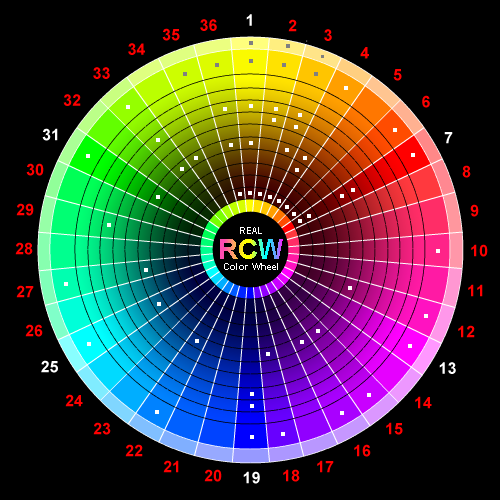
The dots on the colorwheel locate different pigments on 10 different value concentric rings. There are 36 wedges for 36 colors and 10 blocks to dark neutral in each color.
#1.0.9 is the coolest yellow in the yellow arc, a tint of Indian yellow transparent could be #1.00 to #1.09 (two digits for tints, one digit for shades.)
#1.0 is the Pure Yellow wedge with pure color. There are 10 graduated values getting darker below it, there are 36 color wedges in all. Color 36RCW#1, yellow, has five different pigment color values located in it from cool to warmer. 1, 2, 3, 5 and 9. 36RCW#1.0.1
Brown is the darkest intensity of Yellow. Mix this low intensity yellow with it's opposite color Ultramarine blue for a neutral dark.
THIS IS HOW AND WHY THE RCW WORKS.
Element Colors - Crystal and Chemical Colors - Pigment Colors
They all become dark on the same color path.
While painting, darks should be made to match nature by mixing in the opposite complementary color and not by adding black pigments. The same color pigments are used in all media.
This RCW 36 colorwheel has brand pigment names and generic Chemical Class names.
It also includes the pigment chemical names in Chemical Classes
and the Color Index Name and Number. They still use red, yellow and blue as primary colors.
.
Each brand name pigment is a chosen color made from one or more Chemical Classes in combination.
Each Chemical Class color travels on a graduated path changing color as it moves. The ASTM Pigment Color number itself also has a graduated path of different related colors. Different brands, different names, same color.. or close. You have to find the right brand color, start with the Chemical Class color. Daniel Smith did a good job, so did Grumbacher. No one brand has all the best pigment colors and there is no standard for the names they choose to call them.
Example.. From the element Copper we get Copper Phthalocyanine as a Chemical Class with a path from green PG36 with chlorine and bromine to PG7 with just chlorine to Cyan PB15. PB15 has a path from cyan to a transparent ultramarine/blue blue hue at PB15:6, like the crystal Iceland Spar.
PB15.1 has a magenta cast, PB15.3 is pure cyan without added magenta. Grumbacher uses PB15.3 but just calls it PB15.
To paint a sky you need the purest PB15 cyan near the horizon line and by adding magenta or purple you get the sky's zenith color of ultramarine blue.
Blue-Violet is between Cyan and Magenta and is Ultramarine Blue in hue. Blue-Violet is a photo industrial color term for the blue filter used to make the yellow printing plate. Blue is opposite yellow. Red, Green and Blue are primary colors on the Light color wheel only.. red, green and blue are the more saturated RGB colors.
Red and Blue pigment colors are secondary colors and can be made mixing the primary pigment colors of transparent Yellow and Magenta for red and transparent Cyan and Magenta for Blue. Red pigment is not opposite green pigment, they are both secondary colors capable of being mixed with pigment.
As in the RCW, the same brown to yellow color intensity path of yellow is found in both element crystal compounds, and class chemical compounds. The elements lead and iron have oxides with similar ranges of color from yellow to brown and red to brown in synthetic chemicals and natural oxides, just like their crystal counterparts. Pigment color oppositions should match the natural color of the element's crystal oppositions. Just as the lead element only makes yellow and blue crystals (and cyan found in Mexico). The RCW matches the chemical class colors with their paths to darker color intensities.
For we pigment artists, pigment color oppositions should match the element's crystal opposition which can make crushed pigments.
Crystal color paths to darker color intensities move straight across dark to the opposing color.
The Pigment Color numbers mark that color's position on that Chemical Classes path.
Chemical colors and combinations make new brand name colors. Brand color names are still arbitrary. Pigment Color numbers and Color Index numbers are not arbitary and not color logical, and they don't give the pigment's attributes. Which are from transparent to translucent, mono-toned or dual-toned and granular or not. There are over 100 different colors called PR108. The RCW has each color categorized.
The RCW color wheel uses the final color of elements found in crystals, oxides,
chemical colors and vegetable colors, it also works with stage lighting which are the results of RGB colors.
Yellow, orange and red darken to brown in crystals, natural oxides, chemical class pigments and vegetable colors.
Yellow to Brown
Elements in Crystal
The Chrysoberle crystal with the element Beryllium is the standard yellow to brown transparent crystal.
The Citroen Quartz crystal is transparent with the element iron, it includes from yellow to orange to brown.
The opaque Chalcopyrite crystal with iron will show colors from, yellow, orange, tan, red and brown.
Yellow to Brown Chemical Class Pigments
Diarylide Yellow makes these colors.
Diarylide Yellow AAA,
Diarylide Orange, PO34
Diarylide Red, PR166, Disazo Scarlet
Diarylide Brown PY12 brown.
Yellow to Brown Chemical Class Pigments
Monoazo-Aceoacety Benzimidazolone makes this path of intensity for yellow colors, just like oxides and crystals.
Benzimidazolone makes these colors from yellow to brown only, like the Chrysoberle crystal and calcimined lead oxides.
Benzimidazolone Yellow H3g, PY154 CI# 11781, yellow to yellow-orange.
Benzimidazolone Yellow PY151. = Naples Yellow Hue
Benzimidazolone Orange, PO62, 11775. D.S = Permanent Orange.
Benzimidazolone Orange H5g, PO62. Schmincke = Chrome Orange
Benzimidazolone Orange H5g, PO62, Lukas W/C = Helio Genuine Orange.
Benzimidazolone Orange HL, PO36, 11780.
Benzimidazolone Red, Deep Scarlet, PR175, 12513.
Benzimidazolone Carmine, Hf3c, PR176, 12515.
Benzimidazolone Brown, Permanent Brown, PBr25, 12510.
Benzimidazolone Maroon, Napthamide Maroon, PR171,12512
Benzimidazolone Bordeaux PV32, 12517
Yellow to Brown Oxide Pigments, Opaque and Translucent.
- Mars chemical compound colors colors are synthetic iron oxides and follow the same color color intensity scale getting darker as iron oxides. Both are matched on the Real Color Wheel.
- Old Holland, iron oxides, Gold Ocher Light orange side, opaque. Brown Ocher Pale red side. Brown Ocher darker yellow side. Red Ocher dark red side opaque. Brown Ocher Deep is close to Iron Oxide Burnt Umber, translucent.
- Talens, Burnt Umber translucent, PR101, Iron Oxide Brown natural.
- Blockx, Iron Oxide, Venetian Red natural opaque PR101
- Blocks, Iron Oxide, Italian Earth natural translucent high silica content.
- Schmincke, Grumbacher and others, Iron Oxide Raw Sienna, PBr7, translucent high silica content.
- Old Holland, Iron oxide natural colors, Gold Ocher PY43, Brown Ocher Pale,
- Lefranc Bourgeous, Vandyke Brown, PBr8 Manganese Brown.
Dual-Toned Transparent Pigments
Yellow to Orange path in Chemical Class pigments
-Tereachloroindolinone, which makes Isoindolinone Yellow R, a brown/side Indian Yellow.
-Isoindolinone Yellow, PY10, weak dual-tone and PY109.
-Paliotol Yellow-Orange is also slightly dual-toned to yellow PY39
-Anthraquinone, which makes transparent Anthrapyrimidine Yellow PY108 and Flavanthrone Yellow PY112
-Nickel complex and Tartrazine are the primary transparent compounds. They make greens and reds. Transparent PY153, PY150 and PY100 are Indian Yellows. THESE ARE THE MOST IMPORTANT TRANSPARENT YELLOW PIGMENTS since Indian Yellow Original was discontinued in 1900. Not that cadmium opaque yellow or Benzimidazolone translucent yellow should be neglected. Buy your supply while this nickel complex is still availble, 1-6-5.
6-6-6 Golden Acrylics has some new colors in this range. Indian Yellow Golden Hue, Arylide Yellow PY7, Nickel Complex Azo PY150 plus Quinacridone PR206, Transparent, I understand you may call this new pigment to be released in the fall of 2006, Quinacridone/Nickel Azo Gold. Also, for the brown side Indian yellow they have Nickel Azo yellow, PY150.
Yellow to Green path in Chemical Class pigments
Nickel Complex, PG10, Green-gold.
Yellow to Magenta and Yellow to brown Chemical Class pigments.
Quinacridone Gold, RCW36#3.5, dual-tone, Yellow Oxide O/s hue in mass-tone, translucent.
Quinacridone Sienna, #5.6.
Quinacridone Red, #10.1, PR192, Red translucent with magenta under-tone.
Quinacridone Violet, #12.1mass-tone, PV19, Grumbacher Thalo Crimson, opposite Thalo Green.
Quinacridone Magenta Y form, #13.5, mass-tone, PR122, Grumbacher and Liquitex, better for mixing blues and a good neutral with Thalo green.
Alizarin to Red and Brown Chemical Class pigments.
Anthraqinone A Vat Pigment makes these colors.
Alizarin Crimson 1.2 Dinydroxy Anthraqinone, transparent.
Pyanthrone, Red Oxide hue, translucent.
Perylene Red BL, Red, transparent.
Perlene Red, Red-orange. translucent.
Pyantrone Red, Red-Burnt Sienna hue.
Cyan darkens to ultramarine blue hue in these transparent crystals and class chemicals... and the sky above us.
Crystal compounds Cyan to Blue in color depth.
-AZURITE crystal, Cu3[CO3]2[0H]2. COPPER, Standard Azure/Cobalt color, #22.1, [MCCC]. Includes cyan, azure (cobalt blue) and ultramarine blue hue, transparent, translucent and opaque, shows blue in mass.
-CALCITE crystals, CaCO3, trigonal crystals, also aggregate and mass, colorless, transparent and translucent.
-CALCITE crystals w/COPPER, "Iceland Spar crystal", Cyan, allochromatic, polarizing filter. In this crystal light cyan turns into dark ultramarine blue, like in the the Real Color Wheel and Aquamarine crystal.
Chemical class compound pigments Cyan to blue.
The Copper Phthalocyanine chemical class.
-PB15 is a primary pigment color, Daniel Smith calls it Manganese Blue Hue instead of Cyan, but it is the same color, marketing. Manganese does make an excellent cyan.
Phthalocyanine PB15:1 to PB15:6 go through cyan, cobalt blue and ultramarine blue. This color range is as the cyan Iceland Spar crystal, it shows from cyan to ultramarine blue. The color element in both crystal and pigment is copper. The pigment's mass-tone color looks darker than ultramarine blue genuine.
The synthetic chemical class of Ultramarine blue is a complex silicate of sodium and aluminum with sulphur, it makes only slight variations of this blue hue.
-Ultramarine Blue PB29 is translucent. Phthalocyanine Blue PB15.6 is a transparent cyan magenta/side, PB15.1 is cyan green/side.
-Phthalocyanine Blue PB15.3 by Holbein is called a transparent Cobalt Blue Tint. Sinopia calls PB15.3 Royal Blue but it's really cyan (Royal Blue is he English term for Ult. Blue) and as a tint should match the printers cyan print-out.
It is possible that PB15.3 is the perfect color, I don't know what Grumbacher uses, they don't say, but they got it right, so did Hyplar Acrylic's Manganese, using a chlorinated copper phthalocyanine.
True Transparent Test, the under-tone of any tested pigment will not show lighter on a black paper.
Translucent pigments are semi-transparent or semi-opaque, weak opaque colors. Both strong and weak opaque colors all will lighten a black paper, so they are not transparent.
-Aureolin, PY40, Potassium Cobaltinitrite, is not transparent as has always been claimed, it's a translucent, a weak opaque. Chemicals can make a transparent dark brown pigment, oxides can make translucent and opaque pigments.
Here are the transparent yellow chemical pigments.
Indian Yellow can be made with these Chemical Class colors;
-Dioxine Yellow Nickel Complex which makes Nickel Dioxine Yellow Br/s and Green/s PG10F (I think they stopped making this color).
-Disazo, which makes Dairylide Yellow.
-Anthraquinone, which makes Anthrapyrimidine Yellow PY108 and Flavanthrone PY112.
-Tetrachloroindolinone, which makes Isoindolinone Yellow R, a brown/side Indian Yellow.
Using Transparent Yellow.
Indian Yellow is a set of two colors, transparent yellow-orange to yellow PY153 and transparent yellow-brown to yellow PY150. One is a strong yellow to mix with magenta making orange to crimson rose, including bright red, the other is for lower chroma greens and browns. These transparent dual-toned colors mix a lot of greens and reds.
- D.S. New Gamboge, dual toned, Nickel Dioxine Yellow, PY153, CI48545. (Right color, misleading name, gamboge genuine is not a pure yellow)
- Daniel Smith, Indian Yellow (hue), dual toned, Anthrapyrimidine Yellow, Vat Yellow 20, PY108, 68420. dual-toned from yellow to a B/s Raw Sienna hue.
- Lefranc and Bourgeois, Indian Yellow (Imitation), PY153, Nickel Dioxine Yellow Complex, is a translucent dual-toned yellow-orange mass-tone to a cadmium yellow hue under-tone and top-tone. Makes great reds and warm yellows.
- Grumbacher Indian Yellow Hue, PY1 Arylide Yellow G - PO1 Hansa Orange, translucent, less dual-toned than Nickel Dioxine Yellow.
- Talens, Indian Yellow, PY110 Isoindolinone, from yellow-orange-ocher to yellow. Makes clean reds and warm yellows.
- Talens, Gamboge, PY97 Arylide Yellow Fgl, slightly dual-toned orange-ocher to yellow.
- Schmincke, Chrome Yellow Deep (in name only it's not lead chrome), PY83 Diarylide Hr70, from yellow pale to yellow deep dual-tone. Makes clean reds and warm yellows.
- Sennelier, Yellow Lake, PY83 Diarylide Hr70 plus PY43 Yellow Ocher Iron Oxide. These are the same pigments as in Old Holland's Indian Yellow B/s, oil. dual-toned translucent.
- Schmincke, Permanent Yellow Deep, (Indian Yellow Br/s hue), PR154 Benzimidazolone Yellow H3g plus PY10 Isoindolinone Yellow R. Makes clean reds and yellow-orange yellows.
- Sennelier, Yellow Lake, PY83 Diarylide Hr70 / PY43 Yellow Ocher, is not transparent so it is not really a Lake (transparent) color. It's translucent because of the addition of Yellow Ocher Oxide.
- Holbein, Greenish-Yellow, dual-toned, a G/s Indian Yellow.
|
Water Colors are located on the Real Color Wheel for accurate mixing oppositions.
RCW 3, 6, 12, 24, 36 or 360 Color Arcs, 1 to 10 darker and lighter color values.
All opposite colors are complements used to mix shadows and neutral dark.
#1.00.1 Lemon Yellow Chromate
#1.00.2 Nickel Titanate Yellow PY53
#1.00.3 Hansa Yellow Light Arylide PY3
#1.0.1 Zinc Yellow
#1.0.3 Bismuth Yellow PY184
#1.0.4 Indian Yellow B/s Nickel Dioxine PY150
#1.0.5 Aureolin Cobalt PY40
#1.0.5 Tartrazine PY100 (water soluble only)
#1.0.5 Cadmium Yellow Light PY35.1
#1.0.6 Cadmium Barium Yellow Pale
#1.0.9 Indian Yellow O/s Anthrapyrimidine PY108 Tint
#1.0.9 Flavanthrone Yellow is Vat Yellow 1 PY12
#1.2 Gamboge hue mass-tone translucent PY108
#1.4 Italian Warm Gold Ocher - Verona Gold opaque
#1.3 Indian Yell Br/s and Org/s Nickel Diox transp PY153
#1.8 Nickel Azo, mass-tone transl PY150 Br/s - PG10F
#1.10.1 Raw Umber translucent PBr7
#1.10.9 Burnt Umber translucent PBr7
#2.00 Naples Yellow Light opaque
#2.0.4 Hansa Yellow Medium translucent PR3
#2.0.5 Cadmium Yellow Medium, PY35
#2.3 French Ocher R/s opaque PY43
#2.4 Yellow Oxide/Ocher Br/s opaque PY43
#2.10 Burnt Umber translucent PBr7
#3.00 Naples Yellow Deep opaque
#3.0 Cadmium Yellow Deep opaque
#3.3 Raw Sienna translucent PBr7
#3.4 Italian Deep Yellow Ocher R/s opaque
#3.6 Quinacridone Deep Gold PO48 transparent
#3.7 Transparent Brown Oxide PR101
#3.10 Burnt Umber PBr7
#4.0.1 Isoindolinone Yellow R transparent PY110
#4.0.4 Benizimidazolone Orange transparent PO62
#4.0.5 Cadmium Orange PO20 opaque
#4.6 Burnt Sienna translucent
#4.10 Burnt Umber translucent PBr7
#5.7 Italian Burnt Sienna PBr7 translucent
#5.10 Burnt Umber translucent PBr7
#6.0 Vermilion opaque - China Vermilion transl PR188
#6.10 Burnt Umber translucent PBr7
#7.0.5 Cadmium Red Light PR108 - Thioindigoid PR88
#7.5 Wm. Italian Venetian Red opaque PR101
#7.6 Wm. Red Oxide PR101
#7.9 Benizimidazolone Brown transp PBr25
#7.10 Burnt Umber transl PBr7
#12.0 Quinacridone Rose Bata transp PV19
#13.0 Quinacridone Magenta Y transp PR122
#14.0 Cobalt Violet PV49 opaq - Quin Violet PR212
#15.0 Manganese Violet top-tone PV23 (Rs)
#15.6 Manganese Violet mass, PV23 (Rs)
#16.0 Dioxazine Purple T-tone transp PV15
#16.6 Dioxazine Purple mass, transp PV15
#18.0 Ultramarine Violet T-tone, translucent
#18.6 Ultramarine Violet mass, translucent
#19.0 French Ultramarine Blue transl PB29
#19.2 Ultramarine Blue Light transl PB29
#19.3 Ultramarine Blue Deep transl PB29
#22.0 Cobalt Blue opaque PB28
#22.0 Azurite, transp to opaque top-tone, PB28
#22.6 Azurite, transp to opaque mass, PB28
#25.0 Pathalo Blue - Cyan T-tone PB15.3
#25.6 Pathalocyanine Blue - Cyan mass, PB15.3
#27.0 PhthaloTurquiose Top-tone PB15 + PG36
#27.6 PhthaloTurquiose Mass PB15 + PG36
#29.3 Opaque Green Light
#31.0.1 Pathalocyanine Green Y/s T-tone transp PG7
#31.6.1 Pathalocyanine Green Y/s mass, transp PG7
#31.0.10 Pathalocyanine Green B/s T-tone transp PG36
#31.6.10 Pathalocyanine Green B/s mass, transp PG36
#33.3 Permanent Green Light opaque PY3 + PG7
#33.6 Hooker's Green Prm. transp PG36 + PY3 + PO49
#34.6 Chromium Green oxide opaque PG17
#35.0 Lime Green
#36.0 Priderit Yellow Yellow-Green opaque PY157
#36.3 Rich Green Gold Nickel Chelated Azo
#36.7 Green Gold Azomethine or Irgazine Green PY129
#36.10 Green Umber mass, translucent
3 color watercolor palette
Indian Yellow's are PY150, PY153 Nickel Dioxine Yellow and Tartrazine PY100 (water color only), they are equal to the results of Original Indian Yellow O/s.
Warm and cool, one color called yellow. Yellow is in two parts, one to make red and warm colors, one to make green and cooler colors.
Indian Yellow hue, PY108, Anthrapyrimidine and PY150 Yellow are equal to Original Indian Yellow Br/s. PY153 is the Org/s Indian yellow
If I could have only 3 tubes of paint.
Nickel Dioxine and Tartrazine are very important, they tint to Cadmium Yellow's hue.
Quinacridone Magenta, PR122 is the best neutral magenta. PV19 is for just reds, PV212 for just blues.
Pathalo Cyan, PB15
5 color watercolor palette.
Tartrazine PY100 or Nickel Dioxine Yellow PY150
Burnt Sienna natural, PBr7
Magenta, PR122
Ultramarine Blue, PB29
Cyan, PB15
6 color watercolor palette.
Tartrazine PY100 or Nickel complex PY150
Burnt Sienna natural, PBr7
Magenta, PR122 (neutral) or PV19 (warm)
Dioxazine Purple, PV23 R/s
Ultramarine Blue, PB29
Cyan, PB15.3
12 color watercolor palette.
Tartrazine PY100, PY153 for red, Nickel Dioxine Yellow PY150 Yellow for greens.
Cad Yellow Light, PY35
Sienna natural, PBr7
Venetian Red Oxide, PR101
Quinacridone Magenta, PR122
Carbazole Violet, PV23 R/s
Ultramarine Blue, PB29
Cobalt Blue, PB28
Pathalo Cyan, PB15
Turquoise, PB15 / PG36
Green, PG7
Yellow Green
Green Gold PG129, PV19 Rose and have got to be the next two color additions, and than red.
|
49 pigment colors Clickable on a Real Color Wheel. Don't miss it! New window
I wish.. I had a pre-made Purple made with PR122 and PB15, and a transparent Cool Magenta from Cobalt Violet Phosphorous.
Also a Rhodamine Y, PR81, translucent or opaque, permanent. Maimeri calls it Garanium Lake and it's bright but fugitive, so Im told, I haven't tested it.
Opera is a great magenta but it's just the smallest amount fugitive. I just finished a 10-7-8 to 6-7-9 sun test in my van dashboard. Opera held up very well, only the very lightest tints had any change at all where they seemed to become a little warmer. It was still a good magenta color.
Holbine makes a W/C Opera that is more stable but darker.
Caution: While Sennelier has the great PR:122, don't buy the cyan PB:15 it has the right name BUT is not the right color, It looks like PB:5.1, a Prussian blue color. They also have a color called "Indian Yellow Substitute" that is not correct, not transparent and a bad choice with the right name.. It contains an opaque PY:1 and PY:83. Test purchased on 12-15-8. Also, D.S. has the right pigment but a lousy name, "New Gamboge" when it should be Indian Yellow Org/side.
|
NEXT PAINTING Kihei Workshop 1
PREVIOUS PAINTING Baby Brooklyn, W/C, #911, 11-29-03
VIEW THE PAINTING ON LOCATION COLOR FORUM
|

