The Painter in Oil.
Don. good tip.
It is better in fact to settle on one kind of surface
which suits you, and to have a few practical sizes of stretchers which
will pack together well, and work always on these. You will find that
by getting accustomed to these sizes you work more freely on them. You
can pack them better, and you can frame them more conveniently, because
one frame will always do for many pictures. Perhaps there is no one piece
of advice which I can give you which will be of more practical use outside
of the principles of painting, than this of keeping to a few well-chosen
sizes of canvas, and the keeping of a number of each always on hand.
Absorbent. - Some canvases are primed so as to absorb the oil during
the process of painting. They are very useful for some kinds of work,
and many painters choose them; but unless you have some experience with
the working of them, they are apt to add another source of perplexity to
the difficulties of painting, so you had better not experiment with them,
but use the regular non-absorbent kinds.
Don. That paragraph is out of place with Bouguereau
thinking. I think it was added later.
Don. non-absorbent canvas is acrylic primed. Acrylics are what
I prime my white oil palette with, it makes the dry oil paint chip off
easier. A perfect gesso job with glue, chalk and whiting won't show absorbing
or colorization either, or crack when a finger is poked in the back. Oil
prime for oil paint is classical.
These three larger and thicker (brush) sizes come in
very useful often and it would be well if you were to have these too.
Sometimes a thick, long sable brush will serve better than another for
heavy lines, etc.
All these brushes are round. One largish flat sable like this
it would be well to have, but these are all the sables necessary.
Don. This "etc." may be the missing round ferrule, flat
end hair. It's not on the market anymore and was very important. Back when
they were called riggers and liners. A liner has a round furrel and has
no point because it's flat at the end.
Don. Good tip.
The fan brush, is a useful brush, not just to paint with,
but to flick or drag across an outline or other part of a painting when
it is getting too hard and liney. You may not want it but once a month, but
it is very useful when you do want it.
Don. Good tip.
But they will need a careful soap-and-water washing every
little while, beside. The liquid best for use in this cleaner is the
common kerosene or coal oil. Never use turpentine to rinse your brushes.
It will make them brittle and harsh; but the kerosene will remove all the
paint and will not affect the brush.
Page 2/10
The Painter in Oil, by Daniel Burleigh Parkhurst
CHAPTER V: PAINTS
Inasmuch as certain colors are not claimed to be permanent and
others are, it is for you to compose your palette of those which will
combine safely. This you can do with a little care. Some colors are permanent
by themselves or with some colors, but not in combination with certain
others. You should then take the trouble to consider these chemical relationships.
Don, There were a lot of lead pigments in 1900, not so
today. Lead is effected by sulfur and turns brown.
COLOR LIST
Whites. - Zinc White warning is only permanent white, but it lacks
body and is little used. The lead whites, flake, silver, cremnitz, will
darken in time, and will turn yellow with oil, and may change with or affect
change in other pigments. The zinc white is liable to crack. We have no
perfect white, so practically you may consider the lead whites as permanent
enough, as other painters do.
Yellows. - Cadmium is permanent in all three of its forms. It
is a color the permanence of which is of great importance; for its brilliancy
is quite essential to modern painting, and if it were not permanent,
the picture would soon lose the very quality for which the color was used.
The chromes, which are of similar color-quality, are less permanent, and
are almost sure to turn to a horny sort of yellow and a green, which by
their use was bright and sparkling, will, in a few months, lose its freshness
- this cadmium will not do. Cadmium is also to be preferred to chrome,
because it is of a much finer tonality. Greens and yellows made by the admixture
of chrome are apt to be crude as compared with those in which cadmium was
used.
Don. Good tip
Strontian Yellow is a permanent and most useful light
yellow, one of the few cool yellows.
Much to be preferred to all other citron except the pale
cadmium, and can be used in place of that if necessary. They are both
expensive colors of about the same cost.
Don. Bad tip
Naples Yellow was a very prominent pigment with the older
painters. It is still very much used, but in the simplification of your
palette you may as well leave it out, as you can get the same qualities
with cadmium and white. It is durable and safe, but adds another tube
to your palette which you can well dispense with.
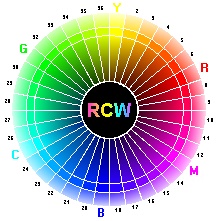
Don. This matches the Real Crystal Color Wheel For
Artists's, Warm Cad Yellow Light pigment color darkening to warm
Burnt Umber in 10 stages.
The ochres are among the oldest and safest of pigments. You can
use them with any colors which are themselves permanent. There are several
of them, a yellow ochre, Roman ochre, transparent gold ochre, and others.
They are all native earths, and though they contain iron, they are sufficiently
inert to be thoroughly sound colors.
The siennas, burnt and raw, are like the ochres, native earths,
very old and permanent colors, and may be used anywhere.
The umbers are in the same class with the siennas and ochres.
They should all rank among the yellows.
Don. Old info.
Indian yellow and yellow lake should both be avoided
as fugitive.
Indian Yellow was permanent. Newer replacements were not.
The newest replacement is isoindolin and it is permanent.
Don. Outdated info.
Aureolin is a rich, warm golden yellow of the greatest permanence,
and should be used when Indian Yellow and yellow lake would be used if
they were permanent.
Isoindolin is a good replacement for Indian Transparent Yellow
Golden. Aureolin is not transparent, it's translucent.
Don. Good tip.
Reds. - The vermilions are permanent when well made.
They are of great body and power, as well as delicacy. They are of two
kinds, - Chinese, which is bluish in tone, and scarlet and orange vermilion,
which have the yellow quality. Both kinds are useful to the palette because
of the practical necessities of mixing.
Light red is a deep, warm red earth, ( Don. Like
Venitian ) made by calcining ochre, and has the same permanence as
the other ochres. It is a fine color, of especial value in painting flesh,
and mixes with everything safely.
Don. Out of date info. Madder is not transparent red, it's transparent
magenta.
The madders-rose, pink, purple, and madder carmine -
are the only transparent reds which are permanent.
Don. Out of date info, these pigments have been replaced.
Whatever the name given them, they should not be confounded
with the lakes, which are absolutely untrustworthy. By reference to
the plates you will see that the madders are practically the same as
the lakes in color when first used. But the lake fade and the madders
do not. The madders cost about twice as much as the lakes; but you must
pay the difference, for the lakes cannot be made to stand, and you must
have the color. There is nothing for it but to pay twice as much and
buy the madders.
The lakes - scarlet, geranium, crimson, and purple - are all bad.
The madders and lakes are all slow dryers; but unless carelessly used
with other colors which are not yet dry they need not have a bad effect
on the picture from cracking. Distinguish the so-called madder lakes and
the lakes; and between carmine, which is a lake, and madder carmine, which
is a madder.
Don. Good tip.
Blues. - The ultramarine of the old masters is practically unused to-day
because of its cost. But the artificial ultramarines, while not quite
of the same purity of color, are equally permanent, and are in every respect
worthy to be used. Of these the brilliant ultramarine is the nearest in
color to the real lapis lazuli. The French ultramarine is less clear and
vivid, but is a splendid deep blue, and most useful.
Don. 1950 info, Today permanent blue transparent is permanent.
The so-called permanent blue is not quite so permanent
as its name implies, but permanent enough for practical purposes.
Don. Bad terminoligy still today. Cerulean Blue is a tint of Thalo blue
which is the pigment transparent cyan.
... one very light and clear, the other darker, which are made
of oxide of the metal cobalt. In oil they are permanent, and do not
change when mixed with other colors. For delicate tints, when the tones
are to be subtly gray yet full of the primary colors, the cobalts are
indispensable. You should always have them on hand, and generally on
your palette. Cerulean blue is of less importance than the other, but
in very clear, delicate blue skies it is often the only color which will
get the effect.
Don. Old info, Cyan Thalo Blue is new replacement for Prussian
Blue.
Prussian blue possesses the depth and power and quality of color
which make it unique. The greenish tone gives it great value in certain
combinations as far as its tinting effect is concerned. But it is not
reliable as a pigment. It changes under various conditions, and fades
with the light. It is not to be depended upon. Antwerp blue, a weaker kind
of Prussian blue, is even more fugitive. It is a pity that these colors
will not stand, but as they will not, we must get along without them.
Don. Poor grade indigo, the highest quality was cyan
transparent. Fugitive.
Indigo has a certain grayish quality which is useful sometimes,
but it cannot be placed among the even moderately permanent colors.
Don. Thalo green new cleaner replacement for Veridian.
Veridian, or emeraude green, is the deepest and coldest
of our greens, and is permanent. It is too cold, and looks even more so
at night. In use it needs the addition of some yellow which holds its own
at night, such as yellow ochre, or the painting will be impossible in gaslight,
or even worse under electric light.
Emerald green is the same as the French Veronese green,
and is generally permanent. It is said to turn dark, and does lose some
of its brilliancy with time and the effect of impure air. But there are
places where one needs it, especially in sketching, and it is well to use
it sometimes. But bear in mind that it is not absolutely permanent, and
as the quality that it gives, brilliant light green, is the very one
it will lose should it change, don't expect too much of it.
Don. no way. Emerald Green is copper arsenate, the most
poisonous of all colors. Freach Veronese was a ferrous hydroxide plus silicic
acid, native, "Veronese green earth", "tirolean", "bohemian", translucent.
This Parkhurst was either a poor student or this has been transcribed
incorrectly.
Other colors. - You will notice that I have said nothing
about the various browns and olives and purples. It is simply because
it is better for you to make all these colors than to get them in the tubes.
The earths and the browns of madder are all good, and the mixing of madders
and good blues will make all the shades of violet and purple you can possibly
want in their purity.
Palettes. - We have, then, a number of pigments which are solid
and safe, of each of the primary colors, and of such variety of qualities
that the whole range of possible colors is practicable with them in combination.
To recapitulate, let us make a list of them.
Don, Notice how many Madder's there are, Rose Madder
was the closest to magenta. Magenta was always an important color in
the past. It was not named magenta but the color was there. There is no
transparent color represention for cyan in this palette.
THE PERMANENT COLORS.
ZINC WHITE.
LEAD WHITE.
LIGHT RED.
ROSE MADDER.
CADMIUM YELLOW.
PINK MADDER.
CADMIUM ORANGE.
PURPLE MADDER.
CADMIUM YELLOW, PALE.
MADDER CARMINE.
STRONTIAN YELLOW.
RUBENS MADDER.
YELLOW OCHRE.
ULTRAMARINE BLUE BRILLIANT
ROMAN OCHRE.
ULTRAMARINE BLUE FRENCH
TRANSPARENT GOLD OCHRE.
PERMANENT BLUE.
RAW SIENNA.
COBALT.
BURNT SIENNA
CERULEAN BLUE.
RAW UMBER.
IVORY BLACK.
AUREOLIN.
BLUE BLACK.
CHINESE VERMILION.
VERIDIAN.
SCARLET VERMILION.
EMERALD GREEN.
ORANGE
VERMILION
TERRE VERTE.
Here is a list of colors which will work well together, and with
which you can do as much as is possible with colors as far as our present
materials go. Most of these colors, I am aware, are among the expensive
ones. This I'm sorry for, but cannot help. The good colors are at times
the expensive ones, but as there are no cheaper ones which are permanent
to take their places, it would be the falsest of economy to use others.
Palette Principles. - In making up your palette, you must so arrange
it that you can get pure color when you want it. There is never any trouble
to get the color negative; to get richness and balance is another matter.
If you will refer to the color plates, you will see that in each of the
three primary colors there are pigments which lean towards one or the
other of the other two.
The scarlet red is a yellow red.
Don. No, the scarlet red is cooler than red.
The Chinese vermilion and the rose madder are blue reds.
Don. No, Chinese Vermillion is Red.
The same holds with yellows and blues, as orange cadmium
is a red yellow.
Don. Orange Cadmium is yellow-red, and strontian yellow
is a yellow-green.
This is, in practice, of the utmost importance,
in the absence of the ideal color, for when we deal with the practical
side of pigment, we deal with very imperfect materials which will not
follow in the lines of the scientific theory of color. If we would have
the purest and richest secondary color, we must take two primaries, each
of which partakes of the quality of the other.
To make a pure orange, for instance, we must use a yellow
red and a red yellow. If we used a bluish red and a bluish (greenish)
yellow, the blue in both would give us a sort of tertiary in the form
of a negative secondary instead of the pure rich orange we wanted. This
latter fact is quite as useful in keeping colors gray without too much
mixing when we want them so, but nevertheless we must know how to get pure
color also. Don. Today we can make a red with transparent yellow
and transparent magenta.
Caracteristics have a bearing on the setting of our palette, for we must
have at least two of each of the three primary colors - red, yellow,
and blue - and white. There may be as many more as you want, but there
must be at least that number.
Don. Cyan was Prussian Blue in 1900 but it is not
mentioned in his pigment list, only the opaque Cerulean blue.
Artists were just learning about the primary cyan.
Don. Today's progression of colors is this: yellow, orange, red, crimson,
magenta, purple, blue, cobalt blue, cyan, turquoise, green, yellow-green.
That is the yellow magenta cyan color wheel, not the red yellow and blue
colorwheel.
These artist's painting from 1800 to 1909 made use of this transparent
Indian Yellow pigment until it was abruptly removed from access by the
maker Winsor Newton in 1909; Vigee-LeBrun, David, Friedrich, Ingres, Carot,
Delacroix, Rousseau, Millet, Courbet, Whistler, Manet, Monet, Pissarro,
Sisley, Renoir, Eakins, Dagas, Cezanne, Seurat, Gauguin, Van Gogh, Sargent,
Ostroukhov, Ripin, Serov, Matisse, Vlaminck, Derain, Bellows, Savrasov,
Pukirev, Perov, Shishkin, Vasilievich, and Polenove.
1826, COLOR, Permanent Alizarin was discovered
1870, COLOR, Cerulean Blue, opaque, permanent, Cobaltous
Stannate, cobalt oxide and tin oxide.
Don. Here is a better list of the pigments available to the
great artists in 1886.
1886-COLOR THE FIRST PUBLIC STANDARD OF PIGMENT COLORS FOR ARTISTS
A. W. Keim, German. "Deutche Gesellschatf zur Forderung rationeller
Malverfahren", The German Society for the Promotion of Rational Methods
in Painting, 1886.
They set up control for the pigments in colors found best by the artists,
to guarantee the color's characteristics and ingredients. These are the
colors deemed necessary by the artists in 1886; 1. White Lead, 2. Zinc
White, 3. Cadmium Yellow Light, Medium and Orange. Cadmium Red wasn't discovered
until 1909, 4. Indian Yellow, 5. Naples Yellow Light and Dark, 6. Yellow
to Brown, Natural and Burnt Ochers and Sienna, 7. Red Ocher, 8. Iron Oxide
colors, 9. Graphite, 10. Alizarin Crimson Madder Lake (a Magenta colored
fugitive pigment) 11. Vermilion, 12. Umbers, 13. Cobalt Blue, Native and
Synthetic, 14. Ultramarine Blue, Natural and Synthetic, 15. Paris-Prussian
Blue, 16. Oxide of Chromium, Opaque and Transparent Viridian, 17. Green
Earth, 18. Ivory Black, 19. Vine Black.
These colors below are very correct in 1900 and today. The cyan hue
Indigo or Prussion Blue is missing in Parkhurst's palette, also the transparent
yellow.
Today, PR122 Magenta is a pigment much stronger in tinting strength
then Rose Madder. The color Thalo Green also strong and pure and is the
opposition of PR122 Magenta. In the foreground the Ultramarine blue pigment
talked about in the Landscape Palette below isn't needed to cool off
the shadows in the foreground as much as the middle ground. Today
this 3 color mix is matched in 2 colors. Because we have a great transparent
purple, we can keep this to the two color mix maxuim. Purple and Green are
split complements. By taking the Blue side tirtiary color of magenta, that
would be purple, and mixing it with green. We would be adding a little extra
cyan to the magenta. This color making technique of today would be a cleaner
equal color to adding Ultramarine Blue to Rose Madder and Veridian.
In 1724 Prussian Blue was invented, it should have been in the Parkhurst
1900 landscape palette.
In1800, W/N Indian Yellow is world wide.
All and all, I do not think the Parkhurst palette is representative
of the best palette at the time.
Bouguereau never mentions a specific palette, but Moreau-Vauthier
is again helpful in this regard; he gives it as:
Naples Yellow (lead antimonate)
Yellow-Ochre
Chrome Yellow, dark
Viridian
Cobalt Blue
White Lead
Light Vermilion
Chinese Vermilion
Mars Brown (iron oxide); this available from Lefranc & Bourgeois
Van Dyck Brown
Burnt Sienna
Ivory Black
Bitumen *transparent yellow-brown*
Genuine Rose Madder, dark *transparent magenta*
All of Bouguereau's colors are still available today as prepared
artist's paints, but not from any single manufacturer. In one of his sketchbooks,
Bouguereau lists so many pigments that no palette could possibly contain
them, but it is interesting to note all the possibilities he had to choose
from.
1869 [Sketchbook No. 5]
Manganese oil -- Leclerc, rue St. Georges...
White lead, (Silver White) Lead carbonate
Ivory Black, Charred Ivory
Minium, Red Lead
Vermilion, Mercuric sulphide
Brown Madder, Iron (charred) Cassius Red, Tin bioxide and gold protoxide
Iodine Scarlet, (English)Mercuric iodine
Purple Red, Mercuric chromate
Madder Lake,
Mineral Yellow, (Paris) Oxi-chloride of lead
Charred Massicot, Lead bioxide and protoxide
Minium, orange, Charred ceruse (lead)
Chrome, Lead Chromate
Orpiment, (King's Yellow) Arsenic sulphide or Yellow sulphide of arsenic
Naples Yellow, Lead oxide and antimonate
Ochre, Hydrated ferric oxide
Indian Yellow, [?](It was a secret of W/N back than. The principal constituent
of Indian yellow is a mixture of the calciun and magnesium salts of euxanthic
acid.)
Prussian Blue, Iron protoxide sulphate and prussiate solution
Mineral Blue, Iron and [?]
Ultramarine Blue, Lapis Lazuli
Cobalt, Cobalt
smalt, Powdered cobalt glass
Ash Blue, Copper
Indigo, Vegetable *cyan*
Violet, Charred iron peroxide Cassius, purple and alumina
Verdigris, Copper acetate
Scheele Green, Copper arsenate
Mountain Green, Copper carbonate
Chrome Blue, Chromium protoxide
Cobalt Blue, (mineral) Cobalt and zinc
Viridian, Sulfate of lime and copper aceto-arsenite
Green Earth, silica, iron oxide, potassium, magnesia carbonate and water
Sap Green, Unripe buckthom berries (lake)
Cassel Earth,
Cologne Earth, Natural earth darkened mostly with bitumen
Umber, Natural earth colored with ferric oxide, manganese dioxide plus
a little bitumen
Sienna, Ochreous natural earth and manganese(bioxide ?)hydrate
Prussian Brown, Charred Prussian Blue
Asphaltum, Bitumen
Mummy, Asphaltum and bone ash
Yellow Lake, Albumen colored with Avignon yellow grains
Cadmium, Cadmium sulfide
Azure or smalt, *Azurite or * powdered cobalt glass
A Landscape Palette. - Landscape calls for pitch and vibration.
You must have pure color and great luminosity, yet a range of color which
will permit of all sorts of effects. The following will serve for everything
out-of-doors, and I have seen it with practically no change in the hands
of very powerful and exquisite painters. There are no browns and blacks
in it because the colors which they would give are to be made by mixing
the purer pigments, so as to give more life and vibration to the color.
The Blackest note may be gotten with ultramarine and rose madder with
a little veridian if too purple; the result will be blacker than black,
and have daylight in it. The ochre is needed more particularly to warm
the veridian. If you paint figures out-of-doors you will need this
same palette. Madder carmine or purple madder, and cerulean blue may also
usefully added to this list.
WHITE.
STRONTIAN YELLOW.
ORANGE VERMILION.
CADMIUM YELLOW.
PINK MADDER.
ORANGE CADMIUM.
ROSE MADDER.
YELLOW OCHRE.
COBALT.
ULTRAMARINE.
VERIDIAN.
EMERALD GREEN.
The umbrella should be larger and tight, and one such
as the illustration, with a valve in the top to let the wind and hot
air through, will be found cooler in less easily blown over.
Don. Good tip
You should have some strong rings sewn on to it, so that
you can fasten it from four sides by strings, to keep it steady if the
wind blows hard. The umbrella should be of light-colored material, preferably
white; but if it is lined with black, the shade will be better, and give
no false glow to the color.
Don. Good tip. Real pictures grow from study of nature.
There are changes which can be made, and be right - made as nature
might make them. Other changes which would be false to nature's ways,
and false to art also. For art works through nature always, and in accordance
with her.
Don. Good tip.
This is the aim of the painter, to express ideas though
nature, not to express notions about nature.
Methods. - Two general methods are at the command of the student
from the first, - to study at once from nature, or to copy. I think
I may safely claim to speak for the great body of teachers who are also
professional artists, in saying that copying is a means of study rather for the advanced student than for the beginner. (Don. I would rather use the current terms, interpreting nature by painting on location. Leave the word copying for copying photographs, which we don't do.)
Don. good tip.
Get to Nature. - If you would really learn to paint,
to see for yourself, to represent what you see in your own way, you cannot
get to nature too soon. Don't bother about what the thing is, so long it
is nature herself. By nature I mean anything, absolutely anything which
exists of itself, not painted. Whether it be the living figure, or a cast,
or a bit of landscape, or a room interior - all things which actually exist
must show themselves by the facts of light falling upon them: the relation
of color, and the contrasts of light and dark. Whatever you see is useful
to you in this way, for these bring about all the qualities and conditions
which you most need to study.
Don. Good tip
Modeling. - In the same way that you have laid out the
proportions in mass lay out your Proportions of light and shade. Model
your drawing by avoiding the small until the large variations of shade
are in place. Avoid seeing curves in relief as you have avoided curves
of outline. Try to analyze the modelling into flat planes, each one large
enough to give a definite mass of relief. Don't be afraid of an edge in
doing this. Let your flat tone come frankly up to the next tone in stop.
This again is not for any effective in itself, but only for facility exactness.
Later you can loose it as much as you see fit in breaking up the drawing
into the more delicate planes, and these again into the most subtle.
Study first the outline and then the planes. Constantly compare
them as to relation; you will find it suggestive. Remember that your
aim is to produce a whole, not a lot of parts, and although a whole includes
the parts, the parts are incidental.
Don. Good tip.
Measurements. - You will always have to use measurements
for the sake of accuracy. Probably you will never be able to dispense
with them. The best way would be to take them as matter of course, and get
so that you make them almost mechanically, without thinking of it. You will
save yourself an immense deal of time and trouble by accepting this at once;
for accuracy is impossible without measurements, and the habit of accuracy
is the greatest time-saver.
Hold your charcoal in your hand freely, so that your thumb can
slip along it and mark off parts of the object when you sight at them
across the coal. Measure horizontal and vertical proportions into themselves
and into each other. Height and breadth are checks to each other. If the
height is a certain proportion of the breadth, then the smaller proportions
of height must have equivalent proportions to each other as well as to
breadth. Measure these and you are sure of being right.
Steps. - Divide your drawing into steps or stages of work. You
will find a helpful thing in studying. You will do it quite naturally
later. Do it deliberately at first, as a matter of training.
First step. - Measure the extreme height and breadth of the whole
group or object of your drawing, with accuracy, and mark each extreme.
Second step. - Outline the great mass of it with the simplest
lines possible. Give the general shape of the whole. This block it in.
Third step. - Measure each of the objects in the group, or the
parts most prominent, if it be a single object. Measure its height and
breadth, both in its own proportion and in proportion to the dimensions
of the other parts and of the whole. Enclose it in straight lines as you
did with the whole mass.
Fourth step. - Find the more important of the lesser proportions
in each object, and block them out also. This should map out your drawing
exactly and with some completeness.
Fifth step. - Lay in simple flat tones to fill in these outlines,
and keep the relations of light and dark very carefully as you do so.
Sixth step. - This should leave your paper with a few large masses
of dark and light, which can now be cut into again with the next smaller
masses, giving more refinement to the whole. This also should so break
up the edges as to get rid of any feeling of squareness or edginess.
Seventh step. - Put in such accents of dark, or take out such
of light, as will give necessary character and force to the drawing.
Chiaroscuro is an Italian compound word whose two parts,
chiar and oscuro, signify simply bright and obscure, or light and dark.
Don. 'bright and obscure'. Means the light source is
obscure. Like a candle behind a hand or any light source hidden.
Primaries and Secondaries. - As all the other shades of
color are produced by the combinations (over-lappings) of the waves
or vibrations in the light rays from the primary colors,
Don. He is using the old primaries of Red Yellow and Blue,
an isosceles triangle, not like the equilateral triangle of YMC. )
we have a series of colors called secondaries, because they are
made up of the rays of any two of the three primaries: as purple, which
is a combination of blue and red.
When dealing with light the secondaries are: shades of
violet and purple from red and blue; shades of orange red, orange, orange
yellow, yellow, and yellowish green from red and green; and bluish green
and greenish blue from blue and green - the character of the color being
decided by the proportions of the primaries in the mixture.
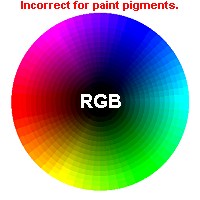
Don. This is the first attempt to make light RGB behave
as pigment.
These conclusions have been reached mainly through experiments
in white light. The primaries so obtained do not hold good with pigment,
as I have stated, but the principles do.
It will avoid confusion if I speak hereafter of the combinations
as they occur with pigment, it being borne in mind that it is a practical
fact that we are dealing with rather than a scientific one.
Don. Here I am really against our writer.
In dealing with pigment the primaries are red, blue,
and yellow, not green.
Don. The fallacy thinking in RYB as primaries:
"If red yellow and green are the primaries of light, just change the
green to yellow and it might work in pigments.."
Below he is going to start..
Of course the secondaries are also changed; and we have
purple and violet shades from red and blue, orange from red and yellow;
and green from blue and yellow - all of which vary in shade with the
proportion of the, mixture of the primaries, as is the case with light.
Don. He has the light primaries right and the pigment
primaries wrong. He is using light's RGB blue as the pigment blue. Pigment
blue (Ultramarine Blue) is a secondary color on the YMC and RCW Crystal Element
Color Wheel, Real Color Wheel, 'RCW' for short.
Tertiaries. - Another class of shades or colors is called
tertiary, or third; for they are mixtures of all the three primaries,
or of a primary with a secondary which does not result from mixture with
that primary.
Tertiaries are all grays, and grays are practically always tertiaries.
If you keep this in mind as a technical fact, it will help you in management
of color.
Don. That was bad teaching, I remember having to do this
drill in college, with the wrong primaries. 1962
Don. Tertiaries are colors all right, colors next to the
secondary colors in a 12 color wheel, not a mixture of three primaries.
Grays are, to the painter, always combinations of color
which include the three primaries. The usual idea is that gray is more
or less of a negation of color. This is not so. Gray is the balancing
of all color, so that any true harmony of color, however rich it may be,
is always quiet in effect as a whole; that is, grayish -good color is never
garish.
Grays made by mixing black with everything are the reverse, and
should not be used except when you use black as a color (which it is
in pigment), giving a certain color quality to the gray that results
from it.
Complementary Colors. - Two colors are said to be complementary
to each other when they together contain the three primaries in equal
strength.
Don. That's correct, but watch what he does with it and
the wrong primaries.
Green, for instance, is the complementary of red, for
it contains yellow and blue; orange (yellow and red) is complementary
to blue; and purple, (red and blue) is complementary to yellow.
Don. And there you have it, the RYB color theory in the late 1800's. All
those complements mix brown, not neutral. All the rest is incorrect, the
RYB colorwheel doesn't work. It doesn't contain magenta or cyan.
The Palette. - You try to attain nature's effects of
light with pigment. Pigment is less pure than light. You cannot have
the same scale,
Don. Yes you can, with the right set of transparent pigment primaries.
Transparent color should not be used alone, but only to modify the tint
of the more solid pigments; for the transparent colors used indiscriminately
are apt to crack,
Don. Today's transparent colors don't crack.
which characteristic is avoided when the heavier color
forms the body of the paint.
Solid Painting. - In most cases solid painting is the safest,
-- the least likely to crack, and the most safely cleaned from varnish
and dirt without injury to the paint itself. It is firmer in character
too, and gives more solidity of effect to the picture.
Mixing. - In mixing colors you should be careful not to over mix. Dont
stir your paint. Too much mixing takes the life out of the color. Particles
of the pure color not too much broken up by mixing are valuable to your
work, giving vibration and brilliancy to it. The reverse is muddiness,
which is sure to come from too much fussing and overworking of wet paint.
Dont use more than three pigments in one tint if you can help it, and
mix them loosely. Put all the colors together, one beside other, drag
them together with the brush, scoop them up loosely on the end of it, and
lay the tint on freely and frankly. Never muddle the color on the canvas.
Dont put one color over another more than you can help; you will only get
a thick mass of paint of one kind mixing with a mass of another, and the
result will be dirty color, which of all things in painting is most useless.
Don. Here we are out of the classic range, I don't why he
concideres himself a student of Bouguereau, he has left behind good classical
blending techniques and moved on to Impressionism. Perhaps he even started the movement.
The free use of oil as a thinning vehicle, although it makes
possible a greater degree of richness of color, is very likely to turn
the picture brown in time. Oil will always eventually have a browning effect
on all paints, even when mixed with them as little as is absolutely necessary.
If you make a tinted varnish of oil (which is practically what a glaze is),
you add so much, to the surely darkening action of the oil on the picture.
Don. Venetian Balsam doesn't yellow like oil and is the basis of a good glaze.
Do not glaze on color which is not well dried. The drying of the
under color and the drying of the glaze are apt to be different in point
of time, and the picture will crack. If they vehicle is the same as was
used in the under-painting and the drying qualities of both paintings
are the same, there is no danger. But when color dries, it shrinks and
flattens, and two kinds of colors shrinking differently are sure to pull
apart, and that causes cracking. If the under-painting is well dry, but
not hard and glossy on the surface, and is capable of still absorbing enough
of the new colors vehicle to bind the coats together, your glaze will stand.
But rather than have it too soft, have the under-painting too hard, and
then before you glaze over it with a little thin, quick drying varnish,
and glaze into that. The varnish will hold the two coats of paint together.
Don. Better to add mastic to your oil, mastic re-desolves making a better bond. You don't have to wait until it under paint has dried.
Don. Good tip.
Frottées. - Closely akin to the glaze in manner, but very
different in use, is the frottée or rubbing. This is generally
used on the fresh surface of the canvas, to rub in the light and shade
or the first coloring of the picture after the drawing is done. It is one
of the safest and wisest ways of beginning your picture. You can either
rub in the picture with a frottée of one color, as sienna or umber,
or you can use all the colors in their proper places, only using very little
vehicle, and making something very thin in tint, somewhat between a glaze
and a scumble. You can make a complete drawing in monochrome in this way,
or you can lay in all the ground colors of the picture till it has much the
effect of a complete painting. Then, as you paint and carry the picture
forward, every color you put on will be surrounded with approximately the
true relations, instead of being contrasted by a glare of white canvas.
A frottée is a most sympathetic ground to paint over.
CHAPTER XXIV: COPYING
Don. He's talking about copying impressive paintings
and studying other's techniques.
Copying may well be spoken of here as it is in a sense a kind
of manipulation. It is a means of study to the student, and a useful,
sometimes necessary process to the painter. In the transferring of the
results of his sketches and studies to the final canvas, the painter
must be able to copy, and to know all the conveniences of it. Before the
painting begins on a picture, the main figures in it must be placed and
drawn on the canvas with reference the plan of it, and their relation
to that plan. This calls for some method exact reproduction of the facts
stored in the artists studies for that purpose. The process of copying
is that method.
This is not the best means of study for a beginner, as I said before.
It trains the understanding of processes rather than the eye; and the
training of the power of perception rather than understanding of methods
is what the young student needs. The processes with which he may put on
canvas the effect he sees in nature are secondary matters to him. Let him
really see the thing and find his own way of expressing it, clumsily, rudely
most probably, it is still the best thing for him. He may take such help
as he can find, as he needs it; get such suggestions as the work of good
painters can give him, when he cannot sees own way. But the searching of
nature should come first. The seeing of what is must precede the stating
of it.
An out-door picture may be still painted in the studio, but it
must be painted from studies made out-doors. It is no longer possible
to pose a model in a studio-light and paint her so into a landscape. It
was right to do it when it was done frankly, when the world had not waked
up to the fact that things look different in diffused in concentrated lights.
It is not right now. You cannot go back of your century. To be born too
late is more fatal than to be born too soon.
Don. Don't confuse paintings not done on location
from life, with the real thing. There is no connection.
Page 8/10
Don. Good tips.
The painter must always sketch from nature. Only by so doing can
he be constantly in touch with her, and received her suggestions unaffected
by of multitudinous facts. The sketch reserves for him the evanescent
effects of nature, which the study would not so entirely, because not
so simply, grasp. The sudden storm approaches; the fleeting cloud shadow;
or the last gleam of after-glow; these, as well as the more permanent,
but equally charming effects of mass against mass of wood and sky, or of
meadow and hill, he can only store up for future use in his sketches.
Dont be afraid of taking measurements. Every one who did anything
worth looking at took measurements. Leonardo laid down a complete system
of proportions. You cant get your proportions right without measurements,
and if your proportions are not right, nothing will be right. Use a plumb-line:
use it frequently, and measure horizontals and verticals. If you are in
doubt about anything, stop a minute and measure. It takes less time than
correcting.
Don. Here starts Parkhurst's painting techniques which I think
are great and right on.
Beginning. - The best way to make a study from still life is to
begin with a careful charcoal drawing on the canvas.
Don. Good tip, for opaque painters, but for transparent
painters who use the ground color as white it's hard to hide the black charcoal
without painting everything opaque, over a white ground you don't always
have to paint opaquely.
The Frottée. - Make, then, a careful light-and-shade
drawing with charcoal directly on the canvas, working in the background
where it tells against the group, but without carrying it out to the
edges of the canvas. Be accurate with your modelling and values, and
keep the planes simple and well defined. Draw all characteristic details,
but only the most important, nearly as if it were not to be painted, but
were to remain a drawing. Fix this drawing with fixative and an atomizer.
In beginning with paint go over the drawing with a thin frottée
which shall re-enforce the drawing with color. You may do this with one
color, making a monochrome painting very thin, leaving the canvas bare
for the lights. Many of the best painters lay in all pictures this way.
What color is to be used is a matter for consideration. It should be one
so sympathetic to the coloring of the whole picture that if it is left
without any other paint over it in places it will still look all right.
Raw umber is a good color, or raw umber modified with burnt sienna
and black. You can make a mixture that seems right. This establishes
your larger values, and gives you something better than a bare canvas,
and something with which you can have a more just idea of the effect of
each touch of color you put on. If there is much variety of color in the
various objects of your composition, it is better to make your frottée
suggest the different colors. Instead of making a monochrome frottée,
rub in each object with a thin mixture, approximating the color and value,
but not solid, nor as strong as it will become when painted, of course. Nevertheless,
you can get in this first rubbing in, a strong effect, which at a distance
has a very solid look, though the relations are not so carefully studied.
When you come to put on solid color with this sort of an under-painting,
it is easy to judge pretty closely of color as well as light-and-shade
relations, and you can work more frankly into it. Into this painting,
when it is dry, you may begin to paint with body color, beginning with the
true color and value of the lights, and working down through the half darks
into the darks. Paint the background pretty carefully as to color and
value, but loosely as to handling. Paint slowly, deliberately, and thoughtfully.
There is no need to pile up masses of wrong color. You should try to be
sure of the color before you lay it on. Study the color in the group, mix
on the palette, and compare them. Think at least two minutes for every one
minute of actually laying on paint. You save time in the end by being deliberate
and by working thoughtfully. Put on color firmly and with a full brush,
but there is no need to load color for the sake of the body of it.
Loaded Light. - It was a principle with the older painters to paint
the shadows thinly and with transparent color, and to load the lights.
It gave a richness to the shadows and a solidity to the lights which
was much valued. But don't think about this; don't let it influence the
frankness of your painting. The theory is in itself largely obsolete now,
and in fact has been disregarded by almost every able painter who ever lived,
in practice, no matter what he said about it. I only speak of it because
almost all books on painting have laid it down as a rule, and you had better
know its true relation to painting. Like all other traditional methods
of painting it has been used by the greatest of painters, and has also been
disregarded by the greatest of painters; and as far as you are concerned,
you may use it or not as suits your purpose. The main thing is to get the
right color and value in the right place, in the most direct and natural,
in the least affected, manner possible. You may work into your frottée,
then, more or less solidly as you feel will give you the best representation
of the color you see.
Solid Painting. - Don't paint always in the same way. It is a mistake
to get too accustomed to one manner of procedure. Different things require
different handling, Let the thing suggest how you shall paint it. If
you want to paint directly, I paint solidly from first to last instead
of rubbing in thinly first. But always have an accurate drawing underneath.
In working solidly without previous laying in, begin where each
brush-stroke will have the greatest effect toward establishing the appearance
of reality. If the canvas is light, begin by putting in the main darks,
and if the canvas is dark, do the reverse. You get the most immediate
effect of reality by the relief; the relief you get most directly by putting
in first those values which contrast with what is already there. Establish
your most telling values first, then work from them towards less immediately
effective things.
Color and Values. - Study the color at the same time you do the
value. Put on no touch of paint as a value or a color alone. If you do,
you will have to paint that spot twice, -once for the value, and again
for the color. You might as well paint for the two qualities in one stroke.
It takes more thought, but it gives you more command of your work. It
doesn't load your canvas with useless paint, and it saves time in the
long run.
Relations and Directness. - Study to give the true relations of
things. Try to get the just color quality. Give it at once. Don't get
it half way and trust to luck and a subsequent painting to correct it.
You will never learn to paint that way. Paint intensely while you paint.
Use all the energy you have. Paint with your whole strength for a half
or a whole hour, and then rest. You will accomplish more so than by painting
all day in a languid, half-hearted way.
Directness. - Directness comes from making up your mind just what
tint of color and value is needed, and just where it is to go, first,
then putting it there with no coaxing. Get the right color on your brush
and plenty of it; then put the brush deliberately and firmly down in the
right place, and take it directly away, and look at the result without touching
it again till you have made up your mind that it needs something else,
and what it is that it needs. Then do that and stop. Directness and justness
of relation are the most important things in painting. They tell for
most, result in most, both to the picture and to the student. Whatever
you do, work for that. Try to have no vagueness in your mind as to what
you will do or why you do it, and the effect of it will show on your canvas.
CHAPTER XXIX: FLOWERS
Flower painting is the refinement of still life. You have the
same control of combination, but you have not the same control of time.
Flowers will change, and change more rapidly than any other models you
can have; and at the same time they are so subtle that the most exquisite
truth and justness are necessary to paint them well.
People seem to think that anyone can paint flowers. On the contrary,
almost no one can paint them well. There are not a dozen painters in
the world who can really paint flowers as they ought to be painted. Why?
Because while they are so exquisite in drawing and color, and so infinitely
delicate in value, they are also even more infinitely subtle in substance
and sentiment.
When you have got the drawing and the color and the value, you
have not got the quality.
What is the petal of a flower? It is not paper, and it is not
wax, neither is it flesh and blood, of the most exquisite kind. All
these are gross as substance compared to the tender firmness of the flower
petal; and the whole bunch of flowers is made up of petals.
Yet you cannot paint the petals either, else you lose the flower.
You must paint the quality of the petal, and the character of the flower.
All these things make the mere perception of facts most difficult, and
it must be done with full knowledge that in an hour it will be something
else, and you can never get it back to its original form again. Yet you
cannot paint a bunch of flowers in an hour. What will you do? Mass and
Value. - There is something besides the flower and the petal; there is the
mass. The mass is one thing, and it is surrounded with air, and air goes
through the interstices of it. You must make this invisible. The difference
in value in flowers is something infinitely little, as a great flower painter
said to me once. Yet the difference is there. The bunch has its nearer
and its farther sides, and the way the light falls on it is the most obvious
expression of it.
When you begin a group of flowers, get the whole first. Make up
your mind that you cannot complete your work from the flower you have
in front of you, and that you must constantly change your models. Do
not paint the little things, the personal things first then. Paint what
is common to all the flowers in the group first. Paint the mass and the
rotundity of it, and express most vaguely the forms of the accents, and
of the darks which fall between the flowers, but get their values. For
you will have to change these, and you should have nothing there which
will influence you to shirk. In this way only can you get the larger things
without hampering your future work by what may be wrong.
Get the large values, and as little as possible the expression
of individual flowers; then as the flowers fade and change, substitute
one or two fresh ones at a time, in this or that part of the partially
wilted group, using the same kind of flower as that which was in that
place before; then work more closely from these new flowers, letting the
whole bunch preserve for you the mass and general relation. As you work,
the bunch will be gradually changing and constantly renewed from part
to part, and you can work slowly from general to particular. Finally, from
new flowers, put in those more individual touches which give the personal
flowers.
This is the only way you can work a long time, and it is not easy.
But it should not discourage you. Nothing takes the place of the flower
picture, and the only way to learn to paint flowers is to paint flowers.
General Principles Hold Always. - Still, the principles of all
painting hold here as elsewhere, and what is said of painting in general
will have its application to flowers.
Paint flowers because you love them; and if you love them, love
them enough to study patiently to express the qualities most worth painting,
even if there be difficulties.
Details Again. - Dont make too much of unimportant things. The
whole is more than the part; the flower than the petal. Of course you
cant paint a flower without painting the petals, but you need not paint
the petals so that you cant see anything else. If the character of the
flower as a whole is to be seen at a glance without the emphasis of any
special petal, suggest the petals only. If the petal is important to the
expression of character, then paint it; and if you do, paint it well.
Use your judgment; make the less expressive of the greater, or do not paint
it at all.
Colors. - Colors and tints in flowers are always more rather than
less subtle than you think them. If you have a doubt, make it more delicate
- give delicacy the benefit of the doubt. Still, flowers are never weak
in color. Subtle as they are, it is the very subtlety of strength. Black
will be the most useless color of your palette. Make your grays by mixing
your richer colors. A gray in a flower is shadow on rich color, and it
must not be painted by negation of color, but by refinement of color.
Sketches. - Make sketches of flowers constantly. Try to carry the
painting of a single flower or of a group as far as you an in an hour.
Practise getting as much of the effect of detail as possible with as little
actual painting of it, and then apply this to your picture.
Get to know your work in studies and sketches, and you will work
better more difficult combinations.
When you have, as you generally will have, still-life accessories
to your flowers, rub in quickly the color and values of the vase or
what not first, but leave the painting of it till the flowers are done.
It will be a more patient sitter than they.
Apply the ways of painting spoken of with reference to still life
to the sketching of flowers. Either rub in quickly a frottée and
then paint solidly into that, and work frankly and solidly but deliberately
to render the characteristic qualities. When you sketch flowers don't
take too many at a time; calculate your work not more than an hour and
a half or two hours, and have no more flowers in your sketch than you can
complete in that time. When you sketch, quite as much as when you work
at more ambitious canvases, get the mass first, especially if the group
is large. Then put in the accents which do most to give the character
or type of the flower. Make studies of single flowers and sketches of
groups. In the study search detail and modelling; in the sketch search
relations and relief, effect and large accent.
Page 9/10
Let your brush follow lines of structure. Don't lay on paint across
a cheek, for instance. Notice the direction of the muscle fibre. It is
the line of contraction of the muscle which give the anatomical structure
to a face. If your brush follows those, you will find that it takes the
most natural course of direction.
Do the same with planes of the body and of the clothing. Note
the lines of action, and the brush-stroke will naturally follow them.
See that the whole form, and particularly the head, 'constructs'.
The head is round, more or less; it is not flat. The planes of it cross
the plane of canvas, recede from it, cross behind, and return. This is
all directions. You must make your painting express this. It is not enough
that there be features, the features must be part of a whole which is
surrounded, behind as well as in front, by the atmosphere. The hair is
not just hair, it is the outer covering of the skull, and of necessity
follows the curves of the skull; and there is a back part to the skull
which you cannot see, but which you can feel-can know the presence of,
because of the way it is connected with the front part by the sides. All
this you must make evident in your painting, as well as the facts which
are on the side of the skull turned toward you. How make it evident? By
values and directness of brush-stroke.
Background. - Never treat the background as something different
from the head. The whole thing must go together. The slightest change
in the background is equivalent to that much change of the head itself.
For the change means necessarily a different contrast, either of color
or light and shade, and it will have its effect on the color or relief
of the head.
Paint the two together, then. Make the head and all that goes
with it or around it as equally parts of the picture, which all tend
to affect each other. Your background is not something which can be laid
in after the head is finished. True you can paint the background immediately
around the head first, and then, after painting the head, extend the background
to the edge of the canvas; but the color, tone, and character of the background
must be decided upon at the time the head is painted, and carried on in
the same feeling.
It is never good work to paint the head and then paint a background
behind it. Particularly if this true when there are windows or any objects
whatever in the background. It is most important that the whole thing
shall be seen in the same kind of light, and in the same relation of light.
This is hardly to be done when the head is one painting and the background
another.
CHAPTER XXXI: LANDSCAPE
FROM the usual rating of figures as the most important branch
of painting, it would be natural to speak of that kind of work first.
But work from the head must come before you attempt the figure, and there
are a good many things that you can learn from landscape which will help
you in figure-work. The manner of painting figures has been much modified,
too, of late years, owing to certain qualities and points of view which
are due to the study of landscape and the important position that it has
come to occupy.
In the old days landscape was only a secondary thing, not only
as a branch of art in itself, but particularly as it was used by figure
painters. In this century it has so broadened in its scope that it is now
recognized to be as important a field of work as any. But further than this,
it has become the most influential study in the whole range of painting.
From the development of the study of outdoor nature, and particularly outdoor
light, it has come about that certain facts of nature have been recognized
which were before neglected, ignored, or unsuspected, and these facts bear
quite as much on the painting of the figure as on the painting of landscape.
So that it is no more possible to paint the figure, in some respects,
as it was painted as a matter of course a hundred years ago, while other
ways of painting the figure, which were undreamed of at that time, are
the matters of course now.
The whole problem of light has taken a new phase, and the treatment
of color in that relation is modified in the painting of figures as well
as in the other branches of work.
Pitch. - In no direction is this more marked than in the matter
of pitch, or key. With the study of landscape, the range of gradation
from light to dark has broadened. A picture may now be painted in a "high
key;" the picture may be, from the highest to the lowest note in it,
far lighter than would have been thought possible even thirty years ago.
This question of "bright pictures" is one which demands consideration.
One has only to go into any exhibition of pictures to-day to be struck
with the fact that the key of almost every picture in it, of whatever
kind, has changed from what it would have been in the last generation.
This is not merely the result of the spread of the "Impressionist" idea.
That influence has only been strongly felt in this country within the
last ten years. It is not that which I am speaking of now I mean the fact
that even the grayer pictures - those which do not in any ordinary sense
of the word belong to Impressionist work - are light in color, where they
would once have been dark, or at least darker, The impressionists have
had a definite influence, it is true; but the work of the earlier "plein
air" men - the men who posed their models out-of-doors as a matter of principle,
who studied landscape out-of-doors - was the first and most powerful influence,
and that of the impressionists, coming along after it, has simply emphasized
and carried it farther.
Bright Pictures. - Whatever may be thought of the work of those
painters who are called "impressionists," it must be recognized that they
have taught us how some things may be possible. And the present quality
of brightness will necessarily be to a certain extent a permanent one in
art. For like it or not as we may, it is true - true to a certain great,
fundamental characteristic of nature. For outdoor light is bright, even
on a gray day. The luminosity of color is too great to be represented
with dark paint or lifeless color. And once this fact is recognized, it
is a fact which will inevitably influence all kinds of work. What is
possible and right at a certain stage of knowledge or recognition may
be impossible when other points of view have once been accepted. We see
only what we look for, and we look for on1y what we expect to see or
are interested to see. You cannot go out-of-doors now and paint as you
would have painted a hundred years ago. Then you would have painted what
you saw then; but you would not have seen nor looked for things which
you cannot help seeing now. For our eyes have been opened to new qualities
and new facts, and once the eyes have been opened to them they can never
be closed to them again.
Average Observation. - I say we see only what we look for, what
we expect to find; anything out of the ordinary is hard to believe at
first. In looking at nature the average observer does not even see the
obvious. Certain general facts he accepts in the general, but as a rule
there is no real recognition of what is there; no perception of the relations
of things; no analysis; no real seeing, only a conventional acceptance
of a thing as a thing. Men look at nature with one idea, and at a picture
of nature with an entirely different idea. Nature in the picture is to most
people just what they have I been accustomed to see in other pictures. They
get their idea or how nature looks from those pictures, and if you show
them a picture differently conceived they have difficulty in taking it
in.
For this reason the "bright picture" does not "look right." I remember
being asked by a man in a modern exhibition what I thought or "these
bright pictures." When I asked which pictures he had reference to, I
found that he meant the work of a man whose whole aim in painting landscape
was, as he once said to me, to get "the just note" in color and value.
One would think that the fact that the whole force of an extremely able
and sincere mind was directed to that purpose, would produce a picture
with at least truth of observation. Yet this was not what my passing acquaintance
wanted to see. The picture he liked, which "had some nature in it," as he
pointed out to me, was an extremely commonplace landscape with a black tree
against a garish sky, reflected in a pool of water. The "bright picture"
seemed to me exquisitely gray and quiet, though high in key, and the one
with "nature in it," harsh and crude, but conventional; and that was just
the point. The average observer wants to see, and does see, in nature what
he is accustomed to accept in a picture as nature.
But a painter cannot go on such a basis. He may paint a dark picture,
but he must find a subject which is dark to do so. He may not paint
daylight with false pitch and false relations, and say he sees it so.
With every liberty for personal seeing, there are still certain facts
so established and obvious that personality must take them and deal with
them, must use them and not ignore them, in its self-expression.
The pitch of daylight is one of these facts. Light and luminosity
may not be qualities which appeal to your temperament. You may therefore
not make them the main theme of your painting of landscape; but you cannot
paint a daylight picture without in some way making it obvious that luminosity
is a fundamental characteristic of day light. There is no other quality
so universally present and pervasive. In sunlight it is the most vital
quality. You might as well paint water with. out recognizing the fact
that water is wet, as to paint daylight without recognizing the fact that
diffused sunlight is brilliant.
A Help. - You will find it very useful as a help in seeing pitch
as well as color to have a card with a square hole cut in it to look
through at your landscape. Have one side covered with black velvet and
the other left white. Compare darks with the black, and the lights with
the white, and make the picture compose in the opening as in a frame.
Key and Harmony. - But you should remember that the high key for
out-of-door work does not mean crude nor unsympathetic color, neither
does it mean that there is nothing but sunshine and shadow. Your picture
may be as high as you please in pitch, and yet be harmonious and pleasing.
I have seen impressionist pictures of most pronounced type hung in the
same room with old pictures and in perfect harmony with them. It means that
good color is always good color, and will always be harmonious with other
good color, whatever the pitch of either. One picture is simply a different
note from the other, that is all. The color in nature is not crude in not
being dark. The relations of spots of color are just; you have only to be
as just in observing them, and your picture will be harmonious.
Make your notes just all over your canvas. Have some of them just
and the rest false, and of course it will be wrong. Or if you try to
make crudity take the place of brilliancy, you will not get harmony. The
harmony which comes from the presence in just relation of all the colors
is none the less beautiful because more alive. You need not try for the
most contrasting and most sparkling qualities of out-of-door color, but
you should feel for the out-of-doorness of it.
The space, the breadth, lack of confines, the largeness and movement,
vibration and life, - these are the things which the modern painter
has discovered in landscape and has emphasized; and this is what has made
modern landscape a vital force in modern art. Whatever you do or do not
see, feel, and express in your painting, these you must see, feel, and
express for once these qualities are recognized and accepted they are
as universal as the law of gravity, and can be as little ignored.
Landscape Drawing. - Landscape is more difficult to draw than is
generally thought; not only is the character affected by the scale of
the main masses, but there is great probability of overdrawing. The
curves that mark the modelling of the ground are very difficult to give
justly. The altitude and slope of mountains are almost invariably exaggerated.
The twists and windings of roadways and fences are seldom carefully drawn;
yet the most exquisite movement of line is to be gained by just representation
of them. To give the character of a tree, too, without making out too much
of the detail of it, needs more precise observation than it generally
gets.
Get the character; get the sentiment of it. Search for the important
things here first, and be more particular about the placing of each
line than about the number of lines. Don't draw too many lines in a
landscape; don't draw too many objects. Carefully study the scene before
you till you have decided what parts are most essential in giving the
character that you want to express, and then draw most carefully those
parts. See which are the most expressive lines in it. Get the swing and
movement of those lines in the large; then study the more subtle movement
of them. Get these things on the can vas first, and put everything else
in as subsidiary to them. Have all this well placed before you I begin
to paint, and allow for little things being painted on to this.
Don't get too many things into one landscape. The spirit of the
time and place is what will make the beauty of it, not the details nor
the mere facts. This spirit you will find in a few things, not in many.
Having found which lines and forms, which masses and relations of color
and value, express this, the more carefully you avoid putting in other
things the more entirely you emphasize the quality which is the real reason
of existence of your picture.
In studying landscape, work for one thing at a time. What has been
said of sketching and studies applies here. Landscape is the most bewildering
of subjects in its multiplicity of facts and objects and colors and contrasts.
If you cannot find a way to simplify it you will neither know where to
begin nor where to leave off. I cannot tell you just what to do or not
to do, because no two landscapes are alike. Recipes will do nothing in helping
you to paint. But there is the general principle which you may follow,
and I try to keep it before you even at the risk of over- repetition. In
no kind of picture can you drag in unimportant things simply because they
exist in nature. In landscape more than elsewhere, because you cannot arrange
it, but must select in the actual presence of everything, you must learn
to concentrate on the things which mean most, and to refuse to recognize
those which will not lend themselves to the central idea.
Selection. - When you select your subject, or "motif" as the French
call it, select it for something definite. There is always something which
makes you think this particular view will make a good picture. State
to yourself what it is that you see in it, not in detail, but in the
general. Is if the general color effect of the whole, or a contrast? Is
it a sense of largeness and space, or a beautiful combination of line
in the track of a road, or row of trees, or a river? Perhaps it is the
mass and majesty of a mountain or a group of trees. Something definite
or definable catches you -else you had better not do it at all; and what
that something is you must know quite precisely, or you will not have a
well-understood picture.
When you have distinctly in your mind what you want to paint it
for, then see that the composition is so placed on your canvas that that
characteristic is the main thing in evidence. With this done it is a
very easy thing to concentrate on that characteristic, and to leave out
whatever tends to break it up or distract from it. This is the only way
you can simplify your subject. First by a distinct conception of what you
paint it for, then by so much analysis of the whole field of vision as will
show you what docs and what does not help in the expression of it.
Detail. - Much detail in landscape is never good painting. Whether
big or little, your canvas must express something larger and more important
than detail. Give detail when it is needed to express character or to
avoid slovenliness. Give as much detail where the emphasis lies as will
insure the completeness of representation - not a touch more.
Structure. - Have your foreground details well understood in drawing
and value. This does not require the drawing of leaf and twig, but it
does require structure. Everything requires structure. Structure is fundamental
to character. If you will not take the trouble to study the character
of any least thing you put in, don't put it in at all. Nothing is important
enough to put in, if it is not important enough to have its character
and its purpose in the picture understood.
I spoke of structure in speaking of the head. If I said nothing
but "structure, structure, structure" to the end of the section, you
would get the impression of what is the most important thing in drawing.
If you will look for and find the line and proportion expressing the anatomy
which makes the thing fulfil its particular function in the world, you
will understand its character, and that is what is important everywhere.
Work In Season. - Make your picture in the season which it represents-
I don't say that a good summer picture may not be made in winter; but
I do say that you are more likely to express the summer quality while the
summer is around you. There is too much half painting of pictures, and
then leaving them to be "finished up" afterwards.
Of course you can make all your studies and sketches, and then
begin and finish the picture from them. If you are careful to have plenty
of material, to accumulate all your facts with the intention of working
from those facts, all right; but it would be better if you were to work
your picture in the season of it, as long as you are a student at least.
For until you have had a great deal of experience, you will find when
you come to paint your picture that some very much needed material you
have neglected to collect, and you cannot safely supply it from memory.
If this occurs in the time of year represented in the picture, you can
just go out and study it.
Out-of-door Landscapes. - The most important movement in modern
art, the most important in its effects on all kinds of work, is what I
have mentioned as the plein air movement. It was thought by some clear-headed
men that the best way to paint an out-door picture was to take their canvases
out-of-doors to paint it. Instead of working from a few color sketches
and many pencil studies, they painted the whole picture from first to last
in the open air. Working in this way, certain qualities got into the pictures
unavoidably. Necessarily the color was fresher and truer. Necessarily
there was more breadth and frankness, and less conventionality and mere
picture-making. The spirit of the open got onto the canvas, and the whole
type of picture was changed. For the first time out-of-door values were
studied as things in themselves interesting and important. The result
on landscape pictures was that pictures painted in the studio seemed unreal
and insincere, and that men looked and studied less for the making of
pictures, and more for what nature had to reveal.
It would be a good thing for you as a student if you would do as
these men did whenever you want to do any work at landscape, whether
for itself or for background. If you wish to pose any kind of figure with
landscape background, pose and paint your figure out-of-doors. Make sketches
as much as you please, make studies as much as you please; but make them
for the suggestions and knowledge they will give you, and not for material
to be used in painting a picture at home. For your picture, start, and
go on with, and finish it out-doors; you will get a feeling of freshness
and truth in your work which you cannot get any other way. You will also
acquire a power of concentration and of selection and rejection in the
presence of nature which is of the utmost importance to you.
"Impressionism." - It is not possible to speak of landscape and
plein air without mention of the "Impressionists." You should understand
what "impressionism" really is, and what it is not, and what the impressionist
stands for. Whether we like it or not, this work is not to be ignored.
It has tried for certain things, and has shown that they can be much more
justly represented than had before been believed to be possible, and fad
or no fad, that result stands.
In the first place, impressionism does not mean "purple and yellow."
Anyone who says "purple and yellow" and throws the whole thing aside,
is a very superficial critic. The purple and yellow are incidental to
the impressionist, not essential. It is only one of the ways of handling
color by means of which it was found possible to express certain qualities
of light.
Before everything else the real impressionist stands for the representation
of the personal conception and method as against the traditional. He
believes that if a man has anything of his own to say, he must say it
in his own way; and that if he cannot find that nature has anything to
say to him personally, if nature cannot give him a persona1 message, if
he can only paint by giving another man's ideas and another man's method,
then he had better not paint at all; so that whatever he may see to paint,
and however he finds a way to express it, the value of it and the truth
of it lie in the fact that it is his, his way of seeing, and his way of expressing,
- that it is "personal."
Luminosity. - The impressionist is imbued with the fact that all
the light by means of which things are at all visible is luminous -
that it vibrates. He does not think that living light can be represented
by dead color. He strives to make his color live also. This is the secret
of the purple and yellow. By the contrast of these two colors, by the
combination and contrast and juxtaposition of the complementary colors
and the use of pure pigments, he can make his colors more vibrant, and
so give more of the pitch of real sunlight. He actually applies on his canvas
the laws which are known to hold with light and color scientifically. He
applies practically in his work those laws which the scientist furnishes
him with theoretically. The result in some hands is garish, crude. But the
best men have shown that it is possible to use the means so as make a subtle
harmony and a luminous brilliancy that have never before been attained.
The crudity is the result of the man, not of the method.
The Application. - The application of all this to your own work
is that when you want pitch and sunlight you can get it through the observance
of the laws of color contrast, and such a laying on of pigment as will
bring this about. Try to study the actual contrasts of color, not as they
seem, but as they are in nature. Study the facts which have been observed
as to colors in their effects on each other, and then try to see these in
nature and to paint the results.
The Luminists. - This is the principle of all "loose painting"
carried out scientifically. It is the cause of the peculiar technique
of those impressionists who paint in streaks and spots of pigment. The
manner of putting on paint does interfere with the continuity of outline
in the drawing necessarily, but there is a marked gain in the quality
of light; and as these men are "luminists," and light is what they want
primarily, the sacrifice is justifiable, or at any rate explicable.
Now if you understand the scientific principle, and the practical
application and its result on canvas, you have in your hands one of the
main instrumentalities in the rendering of one great quality of out-of-doors.
How far you adopt it is a matter for you to decide for yourself. If the
complete adoption of it implies too much of a sacrifice of other things
of equal or greater value to you, then modify it, or take advantage of
it as much as will give you the balance of qualities you most want. There
is one way to get light and brilliancy and life into your color: adapt
it to your purpose if you need it.
This is the application of color juxtaposition to mixing. The placing
of complementaries so as to increase contrast is another way of adding
to the brilliancy of light. You will find this most useful when you want
to give the greatest possible emphasis to the effect of sunlight and shadow.
If you keep your shadows cool, your lights will be the richer and more
sparkling because of that contrast. If you want more strength in a note
of color, get its complement as near it as you can. Look for their iridescence
of edges of shadow, and of the contours of objects. You will get greater
relief of light and shade by contrast of warm and cool than contrast of
light and dark.
Do not misunderstand me. I am not advising you to be an impressionist.
I wish only that you shall see what there is in this way of looking at
nature and of representation of certain effects of nature, which will
be of use to you in the painting of landscape. I would have you know what
means are at your command, what is possible to accomplish in certain directions,
and how it is possible to accomplish it; then I would have you make use
of whatever will most directly and completely serve your purpose.
Do not use any color or colors, any method or point of view, because
of any advocacy whatsoever. Know first what you want to paint and why.
Let nature speak to you. Go out and look at landscape. Study and observe;
see the effect which makes you want to paint it, and then use the means
and method which seem most entirely, adapted to it. Don't ask yourself,
nor let any one else ask you, Is this So-and-So's method? or, Does this
belong to this or that school? Don't bother about schools or methods at
all. Look frankly to see, accept frankly, and then work to render and convey
as frankly as you have seen. Be sincere - sincere with yourself and with
your painting: then you will surely work at whatever you do from conviction,
and not from fad; and whether it makes you paint as an impressionist or not
is a very minor matter, because sincerity of purpose is the most important
thing in painting, and method of representation one of the least.
Atmosphere. - A universal characteristic of nature will be a fundamental
one in landscape. A landscape which you cannot breathe in is not a perfect
one. We live and breathe in atmosphere, and the expression of atmosphere
will go far to make your landscape true. But atmosphere is not haziness.
Neither is it vagueness nor negativeness of color. Truth of color-quality,
and justness of relation will do most in getting it. You had better not
try for atmosphere as a thing, but as a result. Anything so universal and
so indefinite can be expressed by no one thing. If you try to get it by anyone
means you will miss it. Study, then, the subtlety of color relation and justness
of value. Try to be sensitive to the slightest variety of tone, and be satisfied
with no least falsity of rendering, and you will find that your picture
will not lack atmosphere.
Color of Contour. - An important thing for you to look for and
to study is the color of contours. You will not find it easy; not easy
even to know what it is that you are looking for. But consider it as a
combination of contiguous values and color vibrations, and things will
reveal themselves to you.
No form is composed of unvarying color. No combination of color
surrounding it lacks variety. All along the edge of forms and objects,
of whatever kind, the value and color relation constantly change. The
outline is not constant. Here and there it becomes lost from identity of
value and color with what surrounds it, and again defines itself. The edge
is not sharp. The color rays vibrate across each other. The inevitable variety
of tint and value, of definiteness and vagueness, gives a never-ending play
of contrasts and blendings. These are qualities which go to the harmonizing
of color, to the expression of light, and particularly to the feeling of
atmosphere. This constant variety of contrasting edges is the constant movement
and play of the visual rays, and the study of it gives life and vibration
to the picture, and all the objects represented in it. Outdoors, particularly
when the play of diffused light and the movement of all the objects is
continually felt, either through their own elasticity or because of the
heat and light waves, this study is most necessary, if you would get the
feeling of freedom, space, and air.
Skies. - In the painting of the sky there are several points to
be kept in mind. The sky, even on the quietest day, is full of movement.
Cloud masses change continually. If there are no clouds there is constant
vibration in the blue; constant variety in the plane of color, - a throb
of color sensation which is not to be expressed by a dead, flat tint.
Paint the sky loosely. Lay on the color as you will, with a broad,
flat brush, or with a loose, smudgy handling; put it on with horizontal
strokes, or with criss-cross touches, but never make it a lifeless tone.
Have variety in it; keep a pulsation between the warm and cool color.
You can work in the separate touches of half-mixed color, warm and cool,
all through the sky, so that the whole tone will be flat and even, but
not dense and dead. So far as the sky is concerned, the atmosphere is essential,
and is to be represented not by dense color, but by free, loose, vibrating
color.
Clouds. - If you have clouds to paint, do not draw them rigidly.
Get the effect of the mass and movement, and the lightness of them. As
they constantly change in form, any one form they may assume cannot be
characteristic. The type form is what you must get, and the suggestion
of the motion and lightness. You can suggest, too, the direction of the
wind by the way they mass and sway and flow. The direction of the sun's
rays, too, counts in the color of them. The outline of a cloud mass is never
hard, never rigid. The pitch and luminosity and subtlety are what give you
most of the effect of it.
Study the type of cloud, of course. It is a cumulus, cirrus, stratus
or what not. This character is important; but the character lies ill the
whole body of the cloud form, not in the accidental outlines or the special
position of it for the moment.
Sky Composition. - The massing of cloud forms is a very useful
factor in the composition of the landscape. The cloud bank or cloud line
is capable of giving accent or balance to the picture. As it is not constant
in position any more than in form, you can place it with truth to nature
pretty nearly always where it will do the most good as an element in
the composition. Make use of them, then, and study the forms and the possible
phases of them so as to make the best use of them.
Diffused Light. - Much of the characteristic quality of out-door
light is the result of the diffusion of light due to both the refraction
and the reflection of the sky. The light which bathes the landscape comes
in all directions from the sky. Necessarily, then, the sky will be in
most cases far higher in value than anything under it. Even the blue of
the sky, which looks darker than some bit of light in the landscape, you
will find, if you can manage to get them to tell against each other, will
be the more luminous of the two, and will look lighter. There are times
when the sun glares on a white building or a piece of white sand, when
the white tells light against the blue. But these are exceptions, and
if we could get a blue paint which would give the intensity of color, and
also the brilliancy of the light, even these cases would be most truly
represented with the sky as the higher value. It is a case of whether to
sacrifice value to color, or the reverse, as we cannot have both
Sometimes, however, in a storm, the dense dark of the storm sky
is really lower in value than some white object against it, especially
if there be a bit of sun breaking through on it.
But in general, nevertheless; you should consider the sky as always
lighter and more luminous than anything under it.
Three Planes. - It will help you in understanding the way the light
falls on landscape to consider everything as in one of three planes,
and these planes taking greater or less proportions of light according
to the posit ion of the sun with reference to them.
The position of the sun changes from a point immediately over,
to a point practically at right angles to all objects in nature. Everything
that can exist under the sun will come in one of these planes, and at
some time in the day in each. The vertical, the horizontal, or some sort
of an oblique between these two. If the sun is overhead exactly, the flat
ground, the tops of trees and houses, will get the full amount of sunlight.
The vertical planes, sides of houses, depths of foliage, etc., will get
the least, some of them being lighted only by diffused and reflected light.
The planes lying between these two extremes will get more or less, according
as they are more or less at right angles to the direct rays of the sun.
And as the sun declines from the zenith, the vertical planes get more and
more and the horizontal planes less and less of the light, till in the
late afternoon the banks of trees and sides of buildings and cloud masses
are gilded with light, and the broad horizontal plains of land and water
are in shadow.
However obscured the sun may be, this principle holds more or less;
and it makes clear and helps you to observe and notice many facts in
landscape light and shade which it is necessary to know.
Millet said that all the beauty of color and value, and the whole
art of painting, rested on the comprehension and observance of these
facts.
He said that as the planes of any form turned towards or away from
the light and so got more or less of it, and as one form stood more
or less far back of another and the atmosphere came between, the color
and value changed; and in the observance of this, and its representation
as applied to any and every object or group of objects, lay the whole of
painting. All the possible beauties of the art rested on it. He showed
a painting of a single pear in which these things were most subtly observed,
and said that that painting was as complete and perfect as any painting he
could do simply because in the observance of these relations was implied
the observance of everything which was vital to painting.
Short Sittings. - This characteristic, and the steady change of
position of the sun and its effects on all the objects which are directly
lighted by it, make it necessary, whenever you are painting from nature
out-of-doors, that you should not paint at one thing very long at a time.
The light changes pretty rapidly; at high noon it only takes a few moments
to exactly reverse the light. It is seldom that you can do any just study
for more than an hour or an hour and a half at a sitting. Some men do
work two or three hours, but they are not studying justly all that time;
for that which was light is dark three hours later, and any true study
of value and color is impossible under these conditions. Of course on
gray days this is less marked, but you must suit your sittings to the
time and facts.
t would be better if you had more canvases, and worked a short
time on each, and many days on all. You would have the truest work.
Monet works never more than a half-hour on one canvas; but when
he starts out he takes a half-dozen or more different canvases, and
paints on each till the light has changed.
Theodore Robinson seldom worked more than three-quarters of an
hour, or at most an hour, on one canvas; but, he worked for twenty or
thirty days on each canvas, and sometimes had a single canvas under way
for successive seasons.
Any man who would truly study for the just value and note of color
must, work more or less in this way when he works out-of-doors.
Don. That is how I paint too.
CHAPTER XXXII: MARINES
ALL that has been said on landscape painting applies to marines.
You have the same open-air feeling and vibration of light and color.
There is no need to say the same things over again. It is only necessary
to take all these things for granted, and emphasize certain other things
which are peculiar to the sea.
Color of Water. - You must study the color of water in the large
when you paint it. Remember that its color depends on other things than
what it is itself. The character of the bottom, whether it be rocky
or sandy, and the depth of the water, will affect its color; and to
one accustomed to see these things, the picture betrays its truth or falsity
at a glance, especially as the character of the wave and the great movement
of the whole surface are influenced by the same things.
CHAPTER XXXIII: FIGURES
The broadest classification of figure pictures is to consider
them as of two kinds, - those painted in an out-door or diffused light,
and those painted in an in-door or concentrated light. The painting of
figures out-of-doors will find more difficult if you have had no experience
in painting them in the studio. The problems of light and shade and color
are more complex in the diffused light, and the knowledge of structure and
modeling, as well as of special values gained by studio study, will be
most helpful to you when you paint out-of doors. I should say, then, don't
attempt any serious painting of the human figure in the open air till you
have had some experience with its special problems in the house.
The Nude.- No good figure-work has ever been done which was not
founded on a knowledge of the nude. Whether the figure is draped or not,
the nude is the basis of form. The best painters have always made their
studies of pose and action in the nude, and then drawn the draperies over
that. This insures the truth of action and structure true, which is almost
sure to be lost when the drawing of the form is made through drapery or
clothing. The underlying structure is as essential here as in portrait.
It is the more imperative that the body be felt within the clothes from
the fact that it cannot be seen. There must be no ambiguity, no doubt as
to the anatomy underneath; for without this there can be no sense of actuality.
I do not say paint the nude. On the contrary, if you want to go
so far as that in the study of the figure, you must not attempt to do
it with the aid of a book. Go to a good life class. But I wish to emphasize
the principle that when you undertake to paint anything involving the
figure, you must know something of the structure of what is more or less
hidden, and must make allowance for the disguising of form which the draping
of it will inevitably cause.
And when you draw your figure, you should lay in your main lines,
at any rate, from the nude figure if you can. If you cannot command a professional
model for this purpose, you can only be more careful about your study
of the underlying lines and forms as they are suggested by the saliencies
of the draperies.
If this is the case, be most accurate in those measurements which
place the proportions of the parts which show through the covering,
and try to trace out by the modeling, where the lines would run. By mapping
out these proportions, and drawing the lines over the drapery masses
wherever you can make them out, you can judge to a certain extent of the
truth of action in your drawing.
The use of a lay figure will help you somewhat if you can get one
which is true in proportion. It will not help you much in the finer modeling,
but it will at least insure your structural lines being in the right place,
and that is as much as you can hope for without the special study of the
nude.
A lay figure is expensive, costing about three hundred dollars
in this country. You will hardly be apt to aspire to a full-sized one,
as only professional painters can afford to pay so much for accessories.
But small wooden ones are within the means of most people, and will be
found useful for the purpose I have mentioned, and one should be obtained.
When you have assured yourself, as far as you can by its use with
and without special draperies, of the right action of your drawing, you
must do your painting from the draped model.
The Model. - Never paint without nature before you. If you paint
the figure, never paint without the model. For the sake of the study
of it, it goes without saying that you can learn to paint the figure only
by studying from the figure. But beyond that, for the sake of your picture,
you can have no hope of doing good work without working from the actual
object represented. The greatest masters have never done pictures "out
of their heads." The compositions and esthetic qualities came from their
heads it is true, but they never worked these things out on canvas without
the aid of nature. And the greater the master, the more humble was he in
his dependence on nature for the truth of his facts.
Much more, then, the student needs to keep himself rigidly to the
guidance of nature; and this he can only do by the constant use of the
model.
One Figure or Many. - Whether you have one or more figures, the
problem may be kept the same. The canvas must balance in mass and line
and in color. When you decide to make a picture with several figures, study
the composition first as if they were not figures, but groups of masses
and line. Get the whole to balance and compose, then decide your color
composition. Simplify rather than make complex. The more you have of
number, the more you should consider them as parts of a whole. Keep the
idea of grouping; combine the figures, rather than divide them. Have
every figure in some logical relation to its group, and then the group
in relation to the other parts. Don't string them out or spot them about.
Study the spaces between as well as the spaces they occupy. And don't
fill up these spaces with background objects. That will not bind the group
together, but will separate it. Fill the spaces with air and with values-even
more important!
All this arranged, paint each group and each figure as if it were
one thing instead of many. As you treat the head, the body, the dress,
and the chair as all parts of a whole in a single sitting figure, so treat
the various heads, bodies, dresses, etc., in a group as parts of a whole,
by studying always the relations of each to each. And then study to keep
the different groups as parts of whole canvas in the same way.
Simplicity of Subject. - But do not be too ambitious in your attempts.
Keep your subjects simple. Don't be in a hurry to paint many figures.
Paint one figure well before you try several.
You will find plenty of scope for your knowledge and skill in single
figures. Practice with sketches and compositions, if you will, in grouping
several figures, and try to manage them so that the whole shall be simple
in mass and effect; but do not attempt, as a student, without experience
and skill in the painting of one figure, to paint pictures containing
several. By the time you can really paint a single figure well, you can
dispense with a manual of painting, and branch out as ambitiously as you
please. In the meantime, everything that you have knowledge enough to express
well, you can express with the single figure.
With the model, the background, the pose and occupation, the clothing
and draperies, ad whatever accessories may be natural to the thing as
elements, it is possible to work out all the problems cannot be made
with one figure, more figures will only make it worse.
Look again at Whistler's portrait of his mother. Consider it now,
not as portrait, but as a single figure. What are the qualities of it
which would be helped if there were more in it? The very simplicity of it
makes the handling of it more masterly. Look also at the one simple figure
of painting that are likely to get themselves onto one canvas you will find
in this.
See what movement and dignity there are in it. How statuesque it
is! It is monumental. It has scale; it imposes its own standard of measurement.
There are air and envelopment and light and breadth. Are these not qualities
enough or one canvas?
Nature the Suggester. - Take your suggestions, your ideas, for
pictures from nature. Keep your eyes open. Observe all poses which may
hint of possible schemes of light and shade, of composition, or of color.
It is marvelous how constantly groupings and poses and effects of all
kinds occur in every-day-life. Humanity is kaleidoscopic in its succession
of changes; one after another giving a phase new and different, but equally
suggestive of a picture if you will take the hint. The picture which originates
in a natural occurrence is always true if it is sincerely and frankly painted.
Truth is more various than fiction. It is easier to see than to invent.
And in the arrangement of the material which nature freely and constantly
furnishes to him there is scope for all the invention of man.
ction and Character. - The picture comes from the action -resides
in it. The action comes from the act, and is natural to it, expressive
of it. Any gesture or position which is the natural and unaffected result of an essential action will be true and vital, suggestive of nature,
and beautiful because it will inevitably have character -be characteristic.
The beauty of the picture is not something external to the costumes,
occupations, and life which surround you, but is to be found, contained
in it, and brought out, manifested, made visible, by the mere logical
working out of the need, the custom,or the occasion.
Emphasis is only the salience of the most natural movement.
Daily life swarms with pictures. You do not need to go to other
places and other times for subjects. If you are awake to what is going
on around you, if you see the essential line of the occupation, or the
mass and color which is incidental to every least activity, you will have
more suggested to you than you have time to do justice to. And it is your
business to see the beautiful in the commonplace. Everything is commonplace
till you see the charm in it. The artistic possibility does not lie in the
unusual in any subject, but in the fact that the thing cannot get done without
action and grouping and color and contrast; and these are the artists
opportunities. Keep your eyes open for them; learn to recognize them when
you see them; look for these rather than for the details of the accidental
fact which brings them out. See the movement of it, and the relation of
it to what surrounds it, and you will hardly avoid seeing the picture in
it.
Here is a composition which is an almost literal rendering of
the movement and light and shade effect of a position quite accidentally
seen.
The whole effect of lighting and of line, the grouping and the
pose, resulted purely from the musician's desire to get a good light
on his music. There was no need to add to it. It was simply necessary
to recognize the charm of it, and to represent that charm through it as
frankly as it could be done.
Posing the Model. - Let the character of the model suggest the
pose. If you have a scheme for a picture, choose a model whose personality
will lend itself naturally to the occupation or action natural to that
scheme. Then follow the suggestion which you find in the model. Some
rearrangement will always be necessary if you do not use as a model the
same person who originally gave you the idea for the picture. Every human
being has different manner. You cannot hope for exactly the same expression
in one person that you found in another. But put the model as nearly as
you can in the same situation and pose, and then when the model eases from
the unnatural muscular balance into the one natural to him, you will find
the idea taken from your first observation translated into the characteristics
of your present model.
Never try to place a model in a pose which he can only hold by
an unnatural strain. You will not get a satisfactory result from it.
Study your model; see what pose he most naturally falls into, and then
take advantage of one of these, and arrange your picture with reference
to it.
Never attempt to represent a character in your picture by using
a model of a different class or type from it; you will not be successful
either in painting a lady from a model who is a peasant, nor in painting
a peasant from a model who is a lady. The life and occupation and thought
common to your model will get into your painting of her; and if that is
not in accordance to the idea in the picture, your picture will be false.
The dress, no less than the pose and occupation, must be such as is natural
to your model. The accessories of your picture must befit the character
you wish to paint; otherwise your model becomes no more than a lay figure.
Take note of the characteristics which are peculiar to your model,
and use them; do not change them nor idealize them. Rather paint them
as they are, and make them a vital part of your study of the subject.
This is the best you can do with these characteristics. They may be the
mot expressive thing in your picture. If they are of such a nature that
you cannot use them in this way, then do not use this model at all; you
cannot get rid of these things. In trying to obscure or idealize them, you
only lose character, or paint a character into your model which is unnatural
to him; the result will not be satisfactory.
Quiet Sitters. - An inexperienced painter should not use a model
with too much vivacity of body or of expression. The quiet, reposeful,
thoughtful model, who will change little in position or manner, will
simplify the problem. A model too wide awake or too sleepy will either
of them give you trouble.
Avoid very young children as models, and particularly babies. They
are never quiet, and the problems you will have even with the best of
models will be made enormously more difficult by their restlessness.
For your first work choose models with well-marked faces, and
pose them in a direct light which will give you the simplest and strongest
effect of light and shade.
See that your sitter is in as comfortable a position as you can
get him into, so that the pose can be held easily. Don't attempt difficult
and unusual attitudes. Such things require much skill and knowledge to
take advantage of, and to use successfully. Make your effect more in the
study of composition and color than in fanciful poses. Later, when you have
gained experience, you may do this sort of thing.
If you are painting a face, see that the eyes are in at a restful
angle with the head, and that they are not facing a too strong light,
nor are obliged to look at a blank space. Give them room to have restful
focus, and perhaps something pleasant or interesting to look at.
Length of Pose. - No sitter can hold a pose in perfect motionlessness.
Do not expect it. You must learn to make allowance for certain slight
changes which are always occurring. You must give your model plenty of
rest, too, especially if he be not a professional model. A half-hour
pose to ten minutes' rest is as much as a regular model expects to do
as a rule. If you have a friend posing for you, particularly if it be a
woman. Twenty minutes' pose and ten minutes' rest, for a couple of hours,
is all you should expect; and if the pose is a standing one, this will probably
be more than she can hold- make the rests longer.
An inexperienced model - and sometimes even a trained one-is likely
to faint while posing, particularly if the room be close. Look out for
this; watch your sitter, and see that she is not looking tired. The minute
that you see the least sign of fatigue, if she shows pallor-rest. Do not
get so absorbed in your canvas that you do not notice your model's condition.
If you are observing and studying your model as closely as you should,
you can hardly fail to notice any change that may occur, and you should
at once give her relief.
Distance. - Don't work too near your model, nor too near your canvas.
As regards the first, be far enough away to see the whole of the figure
you are painting, or of that part which you are doing, entirely at one focus
of the eye, and yet near enough to see the detail clearly. If you are too
near, you see parts at a time, and do not see it as a whole. If you are
too far, you see too generally for good study. You might make it a rule
to be away from your subject a distance of about three or four times the
extreme measurement of it. If it is a full length, say fifteen to twenty
feet, if you can get so large a room. If it is a head and shoulders, about
six or eight feet. Never get closer than six feet.
As to your canvas, work at arm's length. Don't bend over - again
you see parts, and you must treat your canvas as a whole. Never rest
your hand or arm on the canvas. Train your arm to be steady. Sit up straight,
hold your brush well out at the end of the handle, and your arm extended;
now and then, if you need closer work, lean forward, and if necessary
use a rest-stick; but as a rule your work will be stronger and hang together
better if you work as I have suggested. Of course you will often get up,
and walk away from your work. Set your easel alongside the model, and go
away to a distance, and compare them. Too intense application to the
canvas forgets that relations, effect and wholeness of impression are
of the greatest importance, and are only to be judged of when seen at some
distance.
Background. - Under the general title of background you may place
everything which will come in as accessory to the figure, and against
or alongside of which it stands. The picture must 'hang together;' must
have envelopment; must be a whole, not an aggregation of parts. Everything
that goes to the making up of this whole must have a natural and logical
connection with it. From the first conception of the picture you must
consider the background as an essential part of it, and as something
which will have a vital effect upon the figure. The color of the background
must be though of as part of, because affecting, the figure itself. The
simplicity or variety in the background, the number of objects in it,
must be considered as to the effect on the figure also. You cannot make
the background a patchwork of objects and colors without interfering with
the effect of the main thing in the picture.
If your figure is simple and quiet, keep the background simply
always. If the character of the case demands some detail, and a variety
of objects, then treat them so that their effect is as simple as possible;
and the figure must be made stronger, in order that the variety in the
background shall not overpower it. Control it by the way the light or the
color masses, or simplify the painting of them. Keep the background in
value as regards prominence and relief of objects as well as in the matter
of color.
Composition o |