Painting on Location
by Donald A. Jusko

Painting with a Knife

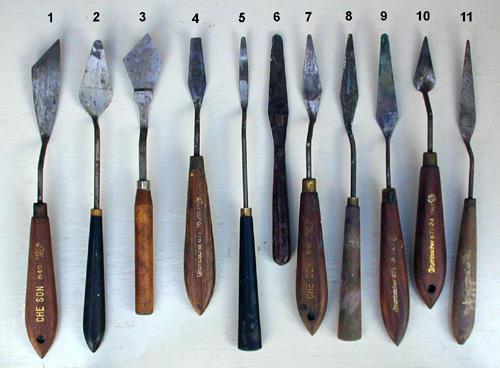
  Different knife blades

These painting images are about 1:1, they were photographed in the morning light because it's whitest.

My 5" x 3/4" spreading blade was out for the picture. It's for applying gesso and making paint.


This was painted with a standard blade, a little larger, but not much, my #9 is a Grumbacher Style 877, size 18. The end is about a 1/4 inch diameter round and 3 inches long. A smaller blade would have a 1/8 " diameter half circle at the tip, like my #8 or my unbroken #4 used to have.

If you hold the painting in your hand, it's easier to get the blade in the right position to apply paint. Spreading the paint is a skill that you will be in control of in a short time.

It's nice to have a long, skinny, parallel edged blade too like my # 5.
#1 is the wide 45 degree angled blade, it is the second best knife shape for larger paintings and it does come in handy. It has both a round side and a flat side.
#2 I don't use much.
#3 is a very flexable very flat broad blade, good for smoothing, hard cutting.
#4 broke but I made it useable. Now they sell a shape like this.
#5 is good for strokes that happen on the ocean.
#6 is a palette knife not a painting knife.
#7-8-9 are normal painting knives for me, The #9 is my favorite.
#10 is tight and #11 is too loose and floppy.

Pre-mixing colors is important for a knife painter. Start with enough white squeezed out to cover the whole painting support. Divide the white paint up into the amount of colors you will pre-mix plus their tints. 

It is very important to use the real color wheel when mixing colors. The Red-Yellow-Blue color wheel will not work because the primary colors are wrong.  The RGB/YMC won't work either, it makes it's darker values incorrectly by using black pigment to match subtracting light.


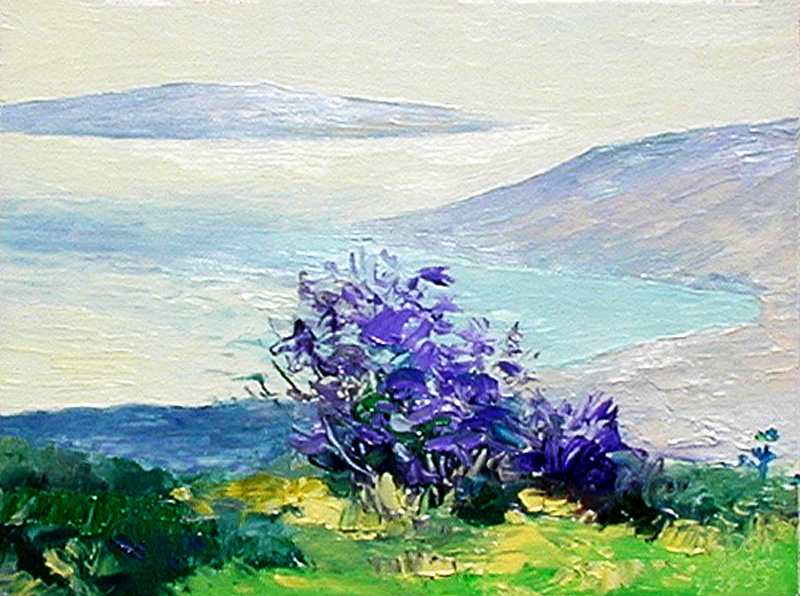
Look at the darkest darks in this painting. They are the combination of Transparent Magenta and Transparent Green.

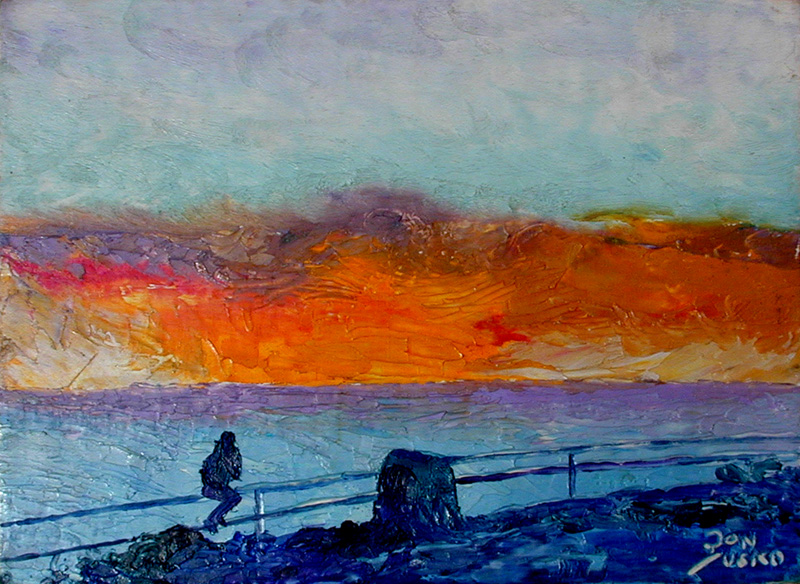
The pink sunlit area to the end of land is tints of the Orange and Cobalt Blue opposition. Paint with oppositions.

7.5x5.5, oil, #892, 4-29-03


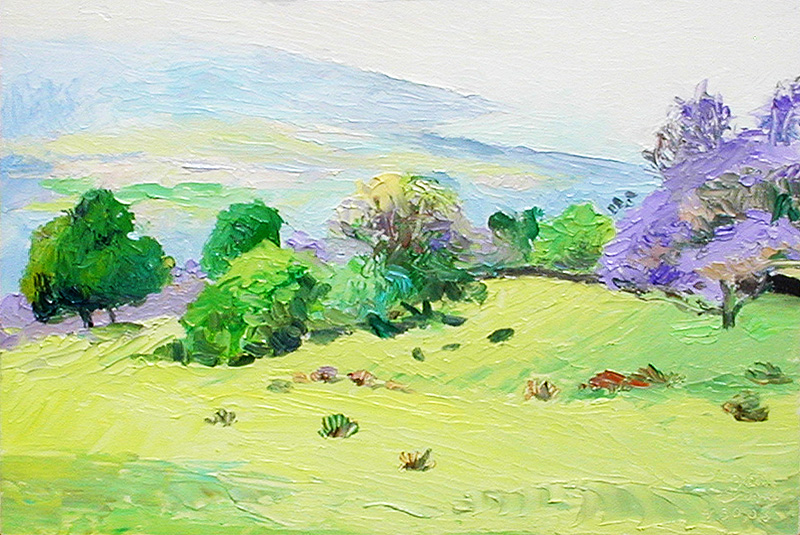
11.5x7.5, oil, #893, 04-30-03
Use your strokes to create direction. Follow the ground or object planes with strokes. The Yellow in this painting is Gamboge.  All with my #9 knife.


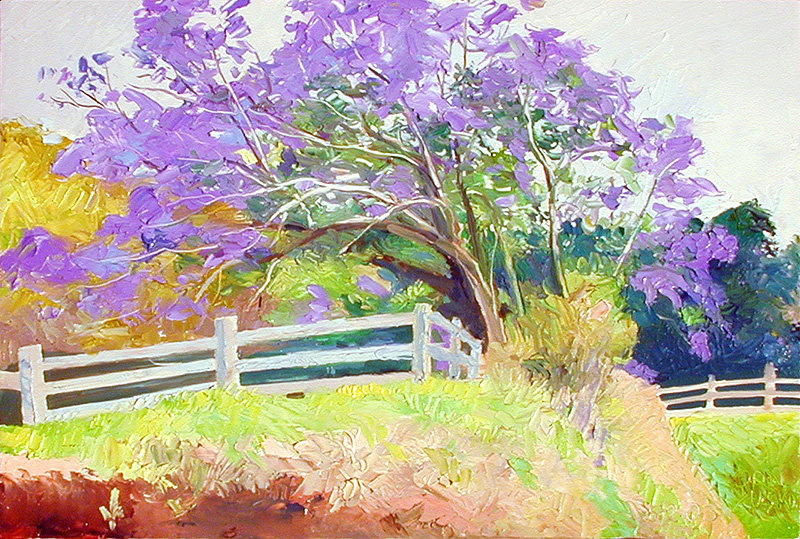
11.5x7.5, oil, #895, 05-02-03
Removing paint as scrape. You can tell I used two, different sized, round tipped blades to make the branches. Both of the standard long trowel shape.  #9 and #8. The fence was done with the 45 degree angled blade. Sign your name with a 3 penny nail or golf tee. Round the nail tip with sandpaper so there are no burrs.

Look at this naturally occurring set if complements in the lower left corner. Cadmium Red and Cyan (Thalo) Blue.

Set your mind to painting the whole painting with the knife. 


5.5x7.5, 1998
Store your wet painting inside the smallest cardboard box it will fit in almost flat. Stagger the stored paintings angles and you can stack wet paintings.

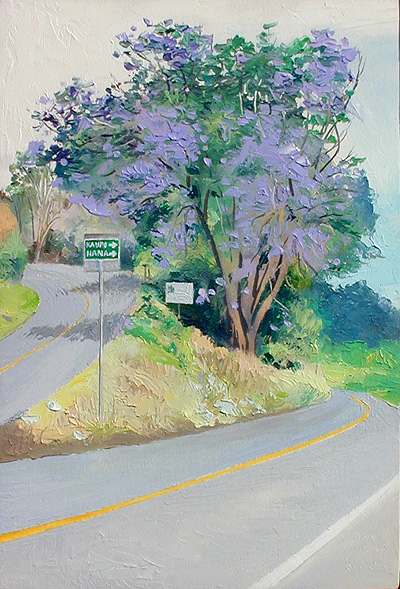
This is the high spot on the West Maui highway. It's called the Pali in Hawaiian.


11.5x7.5, oil, #894, 5-7-03
Here is a very recognizable split in the road, no gas is available for 40 miles. Your heading to the badlands... some of my favorite places. 05-13-03
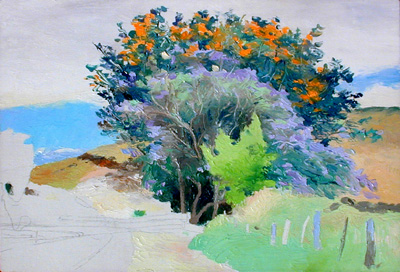
Day 1


#896, 05-17-03
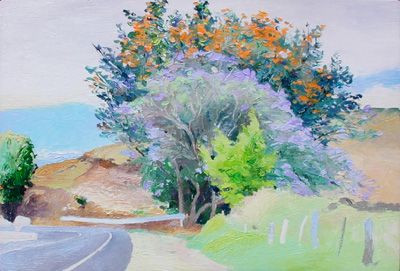
Day 1 and 2. Knife paintings with out any medium dry somewhat in 5 days.
This is 6 hours into an 8 or 9 hour painting.  The Silver Oak and the Jacaranda together. I use a full oil palette to start with, then made tints and combination of color tints that I will be needing. All this is the setup time for knife painting. I really prefer the brush technique of making one color at a time for the stroke that needs it. Ok, I might make a pile for a color I will need a lot of sometimes but never like with a knife.
Jacaranda and Silver Oak Day 2

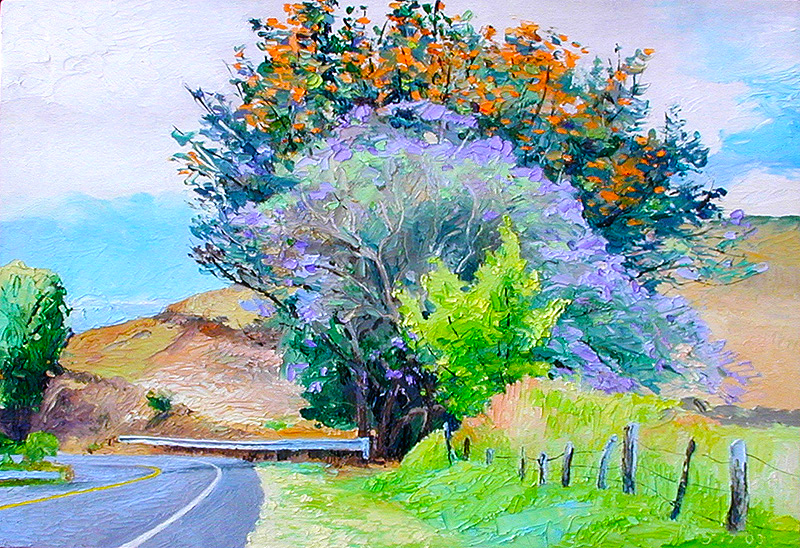
Day 3, 5-17-03, finished.
I did a lot of work with my #10 style blade and a little with my fingers.
To make the fine lines of the barbed wire and some of the branches I thined down the paint a lot with turpintine and just drew with the tips edge.
Day 3, finished

Another Knife painting, Here


NEXT PAINTING, Long's Jacarandas
PREVIOUS PAINTING, Morning Jacaranda, Keokea


JOIN THE PAINTING ON LOCATION WITH COLOR FORUM


Real Color Wheel Course | Site Tree of all links | Galleries with tips 1 | 2 | 3 | 4 | 5 | 6 | 1st paintings with tips | 50th | 100th | 50th | 200th | coloring book examples | color workshop gif/jpg children learning color | rainbows | coloring book | making panel supports | making mediums | brushes that work | my pigments | oil palette map | acrylic palette map | self portraits | 1881 making paints | learn perspective | picturatranslucida | painting waves | painting with alkyd | aerial perspective | coloring page and palette | compare brand colors | permanent transparent colors | large real color wheel charts | Real Color Wheel | match tube colors | 6 important complements making neutral dark | 36 color chips mixing neutral dark | aerial perspective palette | human proportions and painting | links and awards | biography | testimonials | Latest Painting Lesson


Order this complete color course on CD, $35.00.
Order only a 5"X5" Laminated Real Color Wheel $10.00

Painting on Location Join Email list Do you paint with a knife.   Email  Don Jusko


Search For:
Show:   results   summaries

Free .bmp RCW printable zip.

since July 4th, 2003. The CD is MUCH faster then any download ;)